 Back
Back

To thrive in the rapidly evolving work landscape, organisations must become agile, focusing on redesigning work, renewing skills, and re-engineering processes around people and their capabilities rather than just roles or qualifications.
Across the world, organisations are confronting a new reality. Rising business costs, technological disruption, and intensified competition are reshaping industries at an unprecedented pace. Flexible work arrangements and automation are redefining how jobs are structured and where value is created. Analysts estimate that about 92 million workers worldwide will need to change jobs by 2030 due to automation and AI, while 170 million new roles are set to be created.
In Singapore, all jobs have experienced changes in their skills requirements over the past five years. Of these, 43% of the job roles experienced substantive shifts in the tasks performed. Both global and local shifts underscore that transformation can no longer be optional.
There is an urgent need to look beyond academic qualifications to ensure capabilities are adequately captured and capitalised on. Such a move would ensure that the recognition and appropriate rewards given to skills picked up and demonstrated at the workplace.
The Centre for Skills-First Practices (CSFP) was established to help organisations navigate this insight. Through pilot projects, it prototypes skills-first solutions that transform how work is done and how people can grow with their jobs. Two recent CSFP projects with Cragar Industries and the Centre for Healthcare Innovation (CHI) show how very different organisations can use the same five-step work transformation methodology to future-proof their workforce and create meaningful work. Both organisations also saw tangible gains, including more effective deployment of their people based on skills, demonstrating the value of a skills-first approach.
Despite the depth of insights gained, the pilot demanded minimal time from the organisation. The capability transfer and redesign of job roles were completed through two half-day workshops, supported by preparatory work. This shows that meaningful transformation does not require lengthy processes, with the right methodology, organisations can move quickly, build internal capability, and see immediate traction.
Deconstructing work, reconstructing skills at Cragar Industries
Founded in 1990, Cragar Industries specialises in precision manufacturing for the optics and biomedical sectors. Having built a solid reputation over three decades, the company is now positioning itself for its next phase of growth.
Cragar Industries thus partnered with CSFP for a two-part Work Transformation Workshop in July 2025. The workshop brought together the management team, HR personnel, and finance staff to experience the five-step work transformation process first-hand, a structured approach that helps organisations deconstruct, redesign, and rebuild work for agility, human-centricity, and future relevance. It also enabled the team to identify where technology can augment existing roles, as well as surface viable work alternatives that support smoother operations and allow staff to focus on higher-value tasks.
Across the world, organisations are confronting a new reality. Rising business costs, technological disruption, and intensified competition are reshaping industries at an unprecedented pace. Flexible work arrangements and automation are redefining how jobs are structured and where value is created. Analysts estimate that about 92 million workers worldwide will need to change jobs by 2030 due to automation and AI, while 170 million new roles are set to be created.
In Singapore, all jobs have experienced changes in their skills requirements over the past five years. Of these, 43% of the job roles experienced substantive shifts in the tasks performed. Both global and local shifts underscore that transformation can no longer be optional.
There is an urgent need to look beyond academic qualifications to ensure capabilities are adequately captured and capitalised on. Such a move would ensure that the recognition and appropriate rewards given to skills picked up and demonstrated at the workplace.
The Centre for Skills-First Practices (CSFP) was established to help organisations navigate this insight. Through pilot projects, it prototypes skills-first solutions that transform how work is done and how people can grow with their jobs. Two recent CSFP projects with Cragar Industries and the Centre for Healthcare Innovation (CHI) show how very different organisations can use the same five-step work transformation methodology to future-proof their workforce and create meaningful work. Both organisations also saw tangible gains, including more effective deployment of their people based on skills, demonstrating the value of a skills-first approach.
Despite the depth of insights gained, the pilot demanded minimal time from the organisation. The capability transfer and redesign of job roles were completed through two half-day workshops, supported by preparatory work. This shows that meaningful transformation does not require lengthy processes, with the right methodology, organisations can move quickly, build internal capability, and see immediate traction.
Deconstructing work, reconstructing skills at Cragar Industries
Founded in 1990, Cragar Industries specialises in precision manufacturing for the optics and biomedical sectors. Having built a solid reputation over three decades, the company is now positioning itself for its next phase of growth.
Cragar Industries thus partnered with CSFP for a two-part Work Transformation Workshop in July 2025. The workshop brought together the management team, HR personnel, and finance staff to experience the five-step work transformation process first-hand, a structured approach that helps organisations deconstruct, redesign, and rebuild work for agility, human-centricity, and future relevance. It also enabled the team to identify where technology can augment existing roles, as well as surface viable work alternatives that support smoother operations and allow staff to focus on higher-value tasks.
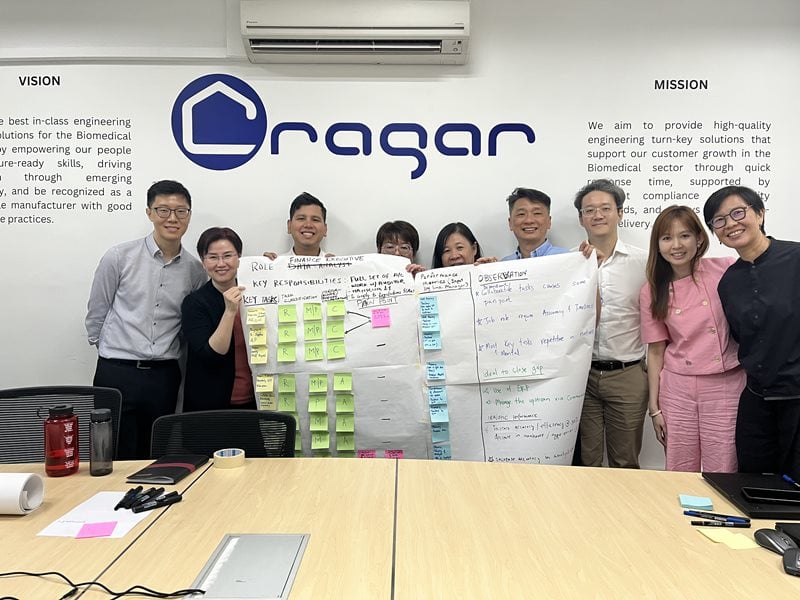
Over two half-day sessions, participants analysed the existing Finance Executive role and reimagined it as a Business Data Analyst, the position that better aligned with Cragar’s move towards digitalisation and data-driven decision-making. Guided by CSFP facilitators, they broke the role down into its component tasks, assessed which could be automated or augmented, and explored how technology could reshape workflows.
Tasks such as generating invoices, collating finance documents, and producing reports were streamlined with automation, reducing time spent from 48.5 hours to just over 18 hours per cycle. The redesigned role incorporated higher-value tasks such as financial analysis, data interpretation, and business insights, which demanded new skills in analytics, digital literacy, and strategic thinking.
Joseph Wong, Managing Director of Cragar Industries, reflected on the experience, “This has not only shown us how work can be deconstructed, reimagined, and rebuilt, but also how it can empower our people and strengthen our organisation. Building on this learning, our management team is committed to deploying the methodology across the rest of the organisation. By doing so, we will gain sharper insights into the effectiveness of our transformation efforts, ensure that our strategic projects are validated with evidence, and make more informed decisions about workforce deployment and upskilling.”
Reimagining healthcare roles: Centre for Healthcare Innovation
The Centre for Healthcare Innovation (CHI), established by the National Healthcare Group, leads efforts to re-shape Singapore’s healthcare system towards value-based and sustainable care. Its partnership with CSFP in August 2025 applied the same skills-first methodology to a vastly different context.
CHI’s teams attended a two-part Work Transformation Workshop to examine how the Senior Staff Nurse role could evolve amid rising expectations and digitalisation. Through guided facilitation, they identified tasks that could be augmented by AI and automation, such as monitoring patients’ health via wearable devices, freeing nurses to focus on complex patient care and leadership functions. They also explored how new competencies in digital fluency, data interpretation, and adaptive problem-solving could be built into future nursing roles.
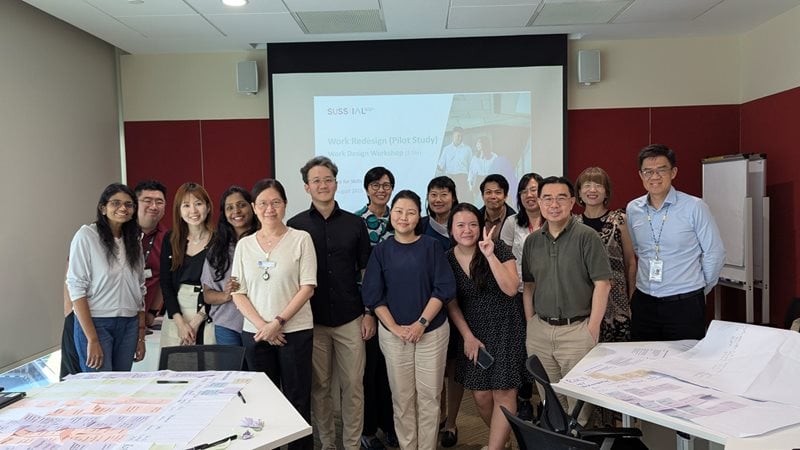
The redesigned role extends beyond patient care to include process improvement, people development, and even the customisation of learning pathways for junior nurses. Crucially, it now integrates AI project management and automation tools, signalling a shift from purely clinical responsibilities towards a hybrid of healthcare expertise and digital enablement.
“This initiative helped our nursing team develop a practical vision for how the Senior Staff Nurse role can evolve. The methodology showed us how AI and automation can support, not replace, clinical expertise while creating real opportunities for professional growth,” shared James Ang, Associate Director of the Centre for Asian Nursing Studies. “Our partnership with the Centre for Skills-First Practices has given us a structured approach to begin preparing our nursing workforce for healthcare’s digital evolution.”
The CHI project also surfaced valuable lessons. Participants highlighted that while the methodology was powerful, time constraints and unfamiliar terminology initially posed challenges. Successful implementation, they noted, depends on strong organisational support, preparation, and the presence of skilled facilitators who can guide complex discussions.
A shared blueprint for transformation
While Cragar Industries and CHI operate in vastly different sectors, their journeys reveal common threads. Both demonstrate that transformation begins not with technology, but with skills, the potential of their people, and the willingness to re-imagine work.
Central to both pilots is the employee-centred nature of the methodology. By grounding transformation in the tasks, skills, and aspirations of workers, the process builds ownership, reduces resistance to change, and ensures that redesigned roles remain meaningful to employees while addressing the needs of the organisation. This people-centric orientation is one of the key reasons the methodology succeeds across the two diverse sectors.
Both projects also show how a structured methodology can demystify transformation. By breaking work down into tasks, organisations can examine which tasks can be automated or redesigned, and mapping new skills to evolving roles, organisations can move from vague ambition to concrete action. The result is a clearer line of sight between business strategy, job design, and workforce capability.
Finally, both point to the growing role of skills intelligence, i.e., the ability to understand what skills are emerging, how they intersect across roles, and where to focus upskilling investment.
As Singapore continues to strengthen its position as a global skills hub, initiatives like those led by CSFP illustrate what a skills-first economy looks like in practice. It is one where businesses redesign work to make full use of human capability, where employees grow through meaningful roles, and where transformation is not a threat but an opportunity to learn and thrive.
Organisations keen to explore the five-step Work Transformation Framework used to guide the organisations in our pilot projects can click here to read more. The systematic process examines how work is structured, organised, and delivered, while integrating technology, workforce skills, and business strategy.