 Back
Back

Since 2020, Singapore’s food exports have grown by more than 11% annually. As the country positions itself as a trusted source of safe, high-quality food products, food safety has become more than a regulatory requirement. It is a strategic capability.
Although reported foodborne illness rates remain relatively low, periodic food poisoning incidents, often linked to lapses in basic hygiene and handling, underscore how small breakdowns can trigger outsized consequences: illness, erosion of consumer trust, and reputational damage across the sector.
Ensuring food safety is therefore not only a matter of public health but also of national importance. At the frontline of this responsibility are food handlers, whose competence and confidence directly shape food safety outcomes.
Training as an assurance and its challenges
In Singapore, training providers offering Food Safety Course Level 1 (FSCL1) to train food handlers face a different but equally complex challenge. They must uphold assessment integrity and regulatory compliance while operating under tight manpower and cost constraints. Balancing consistency, inclusivity, and scalability in how assessment is conducted becomes increasingly difficult as learner profiles become increasingly diverse.
Every adult who wants to work in the food and beverages sector in Singapore has to go through the mandatory FSCL1 assessment. Without the certificate, they cannot work in the sector, whether in restaurants, hawker centres or central kitchens. Yet, the current mode of assessments can be daunting to many. Learners frequently struggle with uncertainties, like how are they expected to perform, how they will be evaluated, and whether taking the test in an unfamiliar language or assessment formats they are unaccustomed to, might undermine their performance.
Adult learners who were not fluent in English — the primary medium of instruction — often struggled to interpret assessment requirements. This is compounded by the diversity of learner backgrounds, including senior workers and workers who come from regional countries. Even when learners possess the practical skills required for safe food handling, these anxieties can erode confidence and impair assessment outcomes.
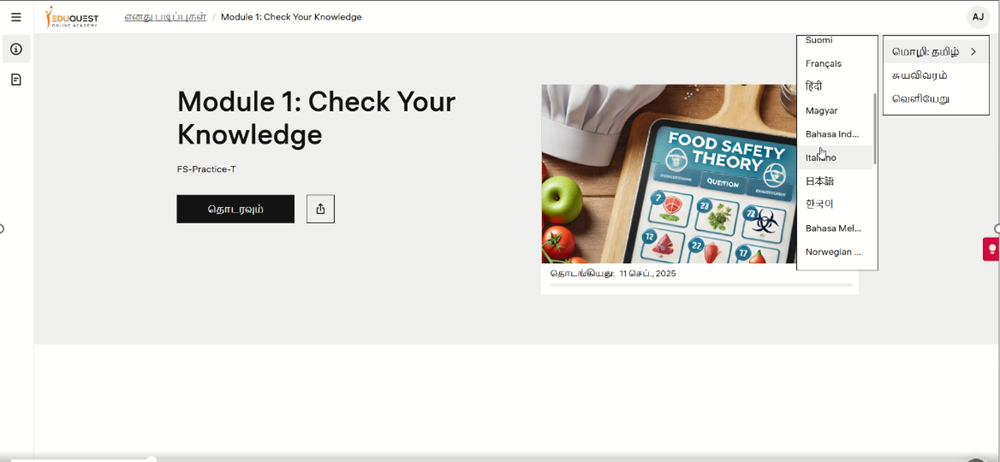
Caption: The Check Your Knowledge module allows learners to practise exam-aligned questions at their own pace before formal assessment. An AI Tutor, which can operate in the learner’s preferred language, is available on demand to clarify concepts, explain correct responses, and address doubts whenever learners need support. (Image provided by Eduquest)
The quest to find a solution
These intersecting challenges formed the starting point of a learning innovation project led by Eduquest International Institute, a private training provider delivering WSQ programmes, in partnership with EdTech solution developer Constructor Tech. The project was supported under the innovPlus Challenge, a national learning innovation programme administered by the Institute for Adult Learning (IAL) and funded by SkillsFuture Singapore (SSG).
Like many training providers navigating daily operational pressures, Eduquest initially framed the challenge in efficiency terms. Constraints such as limited approved training and assessment venues meant that even in-house corporate programmes often had to be conducted off-site, adding logistical complexity. Heavy reliance on manual workflows, coupled with the need for trainers, assessors, and interpreters, further stretched resources.
Eduquest originally thought to turn to technology for productivity improvements, focusing on digitising the assessment process using Extended Reality (XR) glasses and AI-enabled cameras. The idea was to reduce manpower needs, mitigate language barriers, and generate auditable compliance records.
Shifting the centre of gravity
All seems well but a nagging issue remains: while operationally attractive, this framing did little to address the root of the issue – learners’ underlying needs.
Through structured guidance from IAL and external consultants from the Infocomm Media Development Authority (IMDA) Open Innovation Platform, the project team was challenged to reframe the problem.
Instead of asking, “How do we make assessment more efficient?”, the team began asking a more fundamental question: “How do we help learners practise meaningfully, understand expectations clearly, and approach assessment with confidence?”

Loo Zhi Hong, 24, joined Luckin Coffee as a management trainee last October and was enrolled in the mandatory WSQ Food Safety Level 1 course on his second day. Although he had three years of work experience, this was his first role in the food and beverage industry. Unfamiliar with the sector’s expectations, he felt anxious about what the assessment would entail. “I was worried I might misunderstand what assessors were looking for or miss important steps during the practical evaluation,” he said. To better prepare himself, Zhi Hong turned to the new learning system. He used the AI Tutor to practise knowledge questions, receive immediate explanations, and clarify doubts at his own pace. In the VR Practice Zone, he rehearsed hygiene and food-handling procedures in a simulated, low-pressure environment. The opportunity to practise repeatedly helped him replace uncertainty with confidence. “Compared to memorising theories and facts in school, having the chance to practise assured me that I was applying the knowledge correctly at work,” he reflected. He passed both the written and practical assessments on his first attempt. More importantly, he now applies food safety practices with greater confidence and is working towards promotion to assistant store manager. |
Working with Constructor Tech, Eduquest then focused its Virtual Assessor for the Food Safety Course design on four integrated components:
- AI Tutor: An interactive, multilingual tool supporting self-paced learning and clarifying assessment expectations.
- VR Practice Zone: Immersive simulations enabling hands-on hygiene and food handling practice in a safe, repeatable environment.
- AI-Proctored Written Assessment: Secure, compliant digital theory testing aligned to regulatory requirements.
- AI-Monitored Practical Assessment: A 360-degree camera-based evaluation system with automated video analysis and QR-based learner identification.

The solution was piloted with 290 participants over a six-week trial using mixed learning modes, including AI-supported learning, VR practice, and manual assessment components.
Results were encouraging. Overall satisfaction averaged 4.5 out of 5, with more than 90% of participants reporting that training tasks closely mirrored actual assessment requirements. Learners cited the ability to learn in their preferred language and reported higher confidence levels after completing the programme. The system supported self-directed learning and reflective practice while offering standardised, auditable results and formative feedback loops.
Ms Merytantri Kasem, Senior Manager for Quality Assurance & Compliance, Eduquest added, “Assessment anxiety, not lack of ability, was the main challenge faced by our learners. Many adult learners worry about making mistakes even when they already practise safe food handling. After revamping our course and delivery methods, we saw learners entering assessments feeling prepared rather than feeling anxious, and many of them described the experience as fair and manageable."
What changed and why it matters
The Virtual Assessor addressed several long-standing limitations in the traditional training model:
- Greater inclusivity, with learning and assessment available in four languages
- Stronger assessment integrity, supported by AI proctoring and traceable digital records
- Reduced trainer workload, through automated grading and centralised dashboards
- Shorter waiting times, with practical assessment turnaround reduced by up to 50%
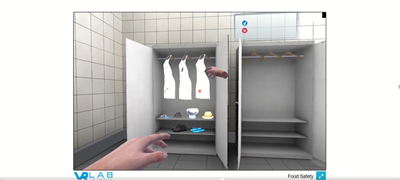
Caption: The VR Practice Module’s immersive allows trainees to rehearse food safety procedures in a realistic and risk-free virtual environment; repeated practice helps them to build muscle memory and improves confidence before the actual practical assessment. (Image provided by Eduquest)
Importantly, the architecture is transferable beyond food safety. Industries such as healthcare, retail, and hospitality — where practical competence, standardisation, and learner confidence are equally critical — can adapt the same assessment-readiness framework. For institutions supporting workforce transformation, the lesson is clear: technology delivers the greatest impact when it is designed not just to optimise assessment, but to prepare learners to succeed in it.
Find out more about the innovation grant schemes administered by IAL here.