 Back
Back

Skills-first is no longer a slogan. It is showing up in how organisations hire, develop and deploy talent. In the tech sector, companies such as Apple, Google, and IBM have long been relying on skills assessments like coding challenges for hiring decisions, instead of using degrees to evaluate candidates. In the financial sector, companies like OCBC, are training senior leaders in coaching to embed skills-first habits into daily management.
As work evolves and industries reshape, talent needs to move based on capabilities. Skills-first is here to stay, making skills more visible, matching people to roles more accurately, and turning learning into real progression and mobility.
However, the implementation of skills-first remains uneven across domains. Singapore, despite substantial government investment in nurturing continuous upskilling and reskilling, ranks 12th in Skills-first Readiness and Adoption in a global index, indicating that there is still room for improvement.
For a skills-first culture to truly take hold, it needs to be embedded as part of wider labour market reform. This was a central thread in IAL’s roundtable in February 2026, Skills-First: Policy and Impact -- lasting impact depends on coordinated change across industrial, labour, and skills policy, so that skills become a shared language for how talent is developed, recognised, deployed and rewarded.
As work evolves and industries reshape, talent needs to move based on capabilities. Skills-first is here to stay, making skills more visible, matching people to roles more accurately, and turning learning into real progression and mobility.
However, the implementation of skills-first remains uneven across domains. Singapore, despite substantial government investment in nurturing continuous upskilling and reskilling, ranks 12th in Skills-first Readiness and Adoption in a global index, indicating that there is still room for improvement.
For a skills-first culture to truly take hold, it needs to be embedded as part of wider labour market reform. This was a central thread in IAL’s roundtable in February 2026, Skills-First: Policy and Impact -- lasting impact depends on coordinated change across industrial, labour, and skills policy, so that skills become a shared language for how talent is developed, recognised, deployed and rewarded.

Caption: Three key ideas emerged from the roundtable discussion on the latest Skills-First Practice Paper
Skills-first is not skills-only
Skills-first does not mean replacing qualifications. In regulated sectors such as healthcare, qualifications remain essential to uphold safety and professional standards. The challenge is to widen recognition so that skills and qualifications work together, especially as roles evolve quickly and many capabilities transfer across adjacent jobs.
Recognition systems are evolving across different economies. In United Kingdom and in the European Union (EU), education providers are offering shorter, validated learning modules that enable incremental upskilling alongside or beyond full qualifications. For the EU, digital credential wallets give individuals agency over upskilling, especially as they transition between sectors.
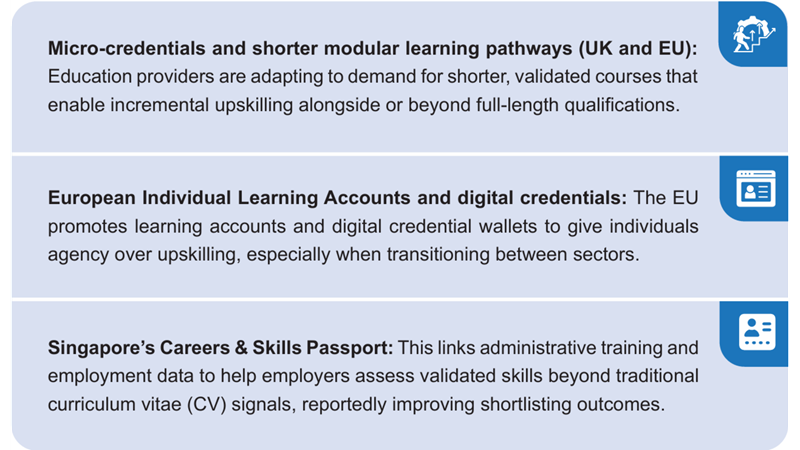
In Singapore, the Careers & Skills Passport launched in 2024 links training and employment data, helping employers assess validated skills beyond traditional CVs and supporting more effective shortlisting. The platform enables users to review their skills and plan their career development, and provides personalised insights into skills and work experience, and the alignment with career goals.
Strengthening skills policy through a coordinated approach
Skills-first efforts often begin start with visible mechanics such as frameworks, taxonomies, and pilots in skills-based hiring. These tools matter but only work at scale when the policies shaping jobs, workers, and training are engineered as one system.
The problem is structural. Industrial, labour, and skills policies are often built in separate silos, each measured by different metrics. Industrial policy prioritises investment, productivity, and job creation. Labour policy focuses on employment standards and protections while skills policy is often measured by access, participation, and training volume. In a silo-ed system, “skills-first” becomes a training agenda rather than a labour market strategy.
A coordinated approach treats skills as shared labour-market infrastructure. When capabilities are described in a common language and backed by trusted validation, people can port their skills across employers and progress more meaningfully. This only works when key agencies share the same picture of skills demand and shortages, and agree on clear pathways for moving workers into new roles and sectors.
Crucially, this coordination needs to sit inside broader labour-market architecture reform. Training alone will not resolve shortages if working conditions, pay, scheduling, or progression remain unattractive. For example, more training will not address the persistent manpower shortage for sectors such as healthcare and eldercare if the jobs themselves are not improved.
Likewise, workers are less likely to invest in retraining if job quality and security are uncertain or if transition risks are borne entirely by individuals. Skills policy lands more effectively when it is coupled with complementary reforms such as job redesign and career structures that create “skill-using” roles, wage and progression signals that reward capability, and enabling supports such as childcare, mobility measures, and targeted protections that reduce the risk of moving between sectors.
From training to impact: the “first mile”, “middle”, and “last mile”
Mr Zhuo Gangwei, Divisional Director at the Ministry of Manpower, offered a visual way to think about how skills translate into jobs: a three-part “skills-to-jobs” journey. This framing helps policymakers spot where current efforts fall short and what else is needed to deliver a truly skills-first labour market and economy.
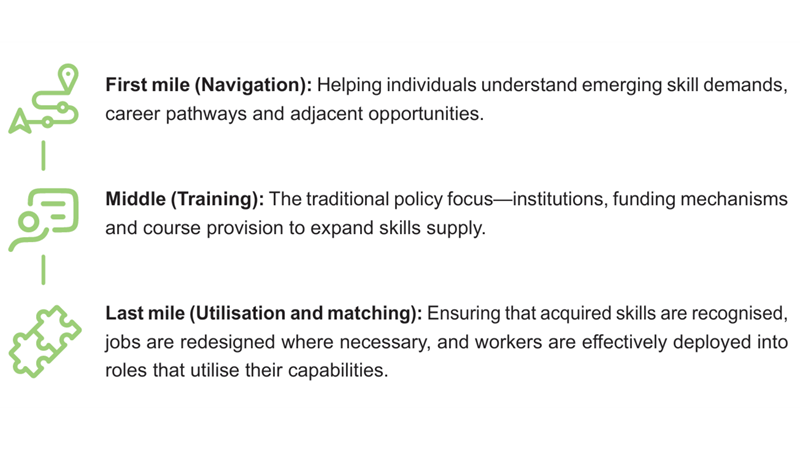
Traditionally, skills-first policies have focused on expanding reskilling and upskilling opportunities. But the “first mile” is just as critical: helping employers and workers navigate skills and labour-market information so they can make better decisions early.
A common barrier is that skills and labour-market data often sit in different parts of government, which weakens coordination and slows feedback. Building skills foresight as a core state capability helps close this gap by using timely labour-market intelligence to steer investment choices, workforce planning, and training provision.
The “last mile” is about turning skills into real job matches. But as hiring becomes more digital and AI-generated resumes become more common, it is getting harder to tell which skill claims are credible. Strengthening this stage means making verified skills information easier to see, trust, and carry across jobs, so employers can hire and deploy people with confidence.
A skills-first ecosystem also depends on the demand side: whether companies actually build, recognise, and use skills as part of how they run and grow their business. In Singapore, efforts to link skills development more closely to industry transformation include:
Skills-first does not mean replacing qualifications. In regulated sectors such as healthcare, qualifications remain essential to uphold safety and professional standards. The challenge is to widen recognition so that skills and qualifications work together, especially as roles evolve quickly and many capabilities transfer across adjacent jobs.
Recognition systems are evolving across different economies. In United Kingdom and in the European Union (EU), education providers are offering shorter, validated learning modules that enable incremental upskilling alongside or beyond full qualifications. For the EU, digital credential wallets give individuals agency over upskilling, especially as they transition between sectors.
In Singapore, the Careers & Skills Passport launched in 2024 links training and employment data, helping employers assess validated skills beyond traditional CVs and supporting more effective shortlisting. The platform enables users to review their skills and plan their career development, and provides personalised insights into skills and work experience, and the alignment with career goals.
Strengthening skills policy through a coordinated approach
Skills-first efforts often begin start with visible mechanics such as frameworks, taxonomies, and pilots in skills-based hiring. These tools matter but only work at scale when the policies shaping jobs, workers, and training are engineered as one system.
The problem is structural. Industrial, labour, and skills policies are often built in separate silos, each measured by different metrics. Industrial policy prioritises investment, productivity, and job creation. Labour policy focuses on employment standards and protections while skills policy is often measured by access, participation, and training volume. In a silo-ed system, “skills-first” becomes a training agenda rather than a labour market strategy.
A coordinated approach treats skills as shared labour-market infrastructure. When capabilities are described in a common language and backed by trusted validation, people can port their skills across employers and progress more meaningfully. This only works when key agencies share the same picture of skills demand and shortages, and agree on clear pathways for moving workers into new roles and sectors.
Crucially, this coordination needs to sit inside broader labour-market architecture reform. Training alone will not resolve shortages if working conditions, pay, scheduling, or progression remain unattractive. For example, more training will not address the persistent manpower shortage for sectors such as healthcare and eldercare if the jobs themselves are not improved.
Likewise, workers are less likely to invest in retraining if job quality and security are uncertain or if transition risks are borne entirely by individuals. Skills policy lands more effectively when it is coupled with complementary reforms such as job redesign and career structures that create “skill-using” roles, wage and progression signals that reward capability, and enabling supports such as childcare, mobility measures, and targeted protections that reduce the risk of moving between sectors.
From training to impact: the “first mile”, “middle”, and “last mile”
Mr Zhuo Gangwei, Divisional Director at the Ministry of Manpower, offered a visual way to think about how skills translate into jobs: a three-part “skills-to-jobs” journey. This framing helps policymakers spot where current efforts fall short and what else is needed to deliver a truly skills-first labour market and economy.
Traditionally, skills-first policies have focused on expanding reskilling and upskilling opportunities. But the “first mile” is just as critical: helping employers and workers navigate skills and labour-market information so they can make better decisions early.
A common barrier is that skills and labour-market data often sit in different parts of government, which weakens coordination and slows feedback. Building skills foresight as a core state capability helps close this gap by using timely labour-market intelligence to steer investment choices, workforce planning, and training provision.
The “last mile” is about turning skills into real job matches. But as hiring becomes more digital and AI-generated resumes become more common, it is getting harder to tell which skill claims are credible. Strengthening this stage means making verified skills information easier to see, trust, and carry across jobs, so employers can hire and deploy people with confidence.
A skills-first ecosystem also depends on the demand side: whether companies actually build, recognise, and use skills as part of how they run and grow their business. In Singapore, efforts to link skills development more closely to industry transformation include:
- SkillsFuture Enterprise Credit (Singapore): supports firms to align upskilling with business transformation priorities.
- Queen Bee industry-led training model (Singapore): enables larger firms to train beyond their own workforce to support sector and supply chain capability needs.
Making skills-first deliver sustained impact
Skills-first has strong potential to support more dynamic labour markets and more inclusive growth. Realising that potential depends not only on strengthening individual programmes, but on how well the system works end-to-end, from foresight and navigation, to training, to matching and utilisation.
In this sense, skills-first is not a single reform to be rolled out. It is a coordinated shift in how economies value, develop and deploy human capability, one that becomes more powerful as institutions, employers and workers align around common signals and shared outcomes.
For detailed insights, click here to read the working paper and roundtable insights on Skills-First: Policy and Impact