 Back
Back

Work is changing faster than conventional job titles can keep up. As AI takes over routine tasks and reshapes workflows, many job roles are being reconfigured. The World Economic Forum estimates that by 2030, 39% of key skills in the labour market will have changed, with AI projected to displace roles while creating new ones. Yet many companies are still hiring for yesterday’s job while screening candidates based on past credentials, rather than on whether they can learn adjacent skills and grow into redesigned roles.
For employers, talent matching is harder than ever. What is driving this mismatch is not simply a shortage of talent. It is that technology, especially AI, is rapidly changing the mix of tasks within roles. This widening skills gap is affecting employers’ hiring confidence. In Singapore, a 2025–2026 survey found that only 23.2% of hiring managers felt confident about finding qualified local talent, while 65.1% cited skills mismatch as a key hiring challenge. Another survey reports that 77% of employers in the Asia Pacific region struggle to find skilled talent.
Technology changes tasks. Work redesign reorganises work. Skills-first makes it actionable.
Technology and AI disruption, work redesign, and skills-first practices form a connected chain—but not in a purely technology-driven sequence. The process begins with how work is understood and reorganised.
Technology changes tasks by enabling automation, augmentation, and new ways of performing work. For example, with an AI assistant, a customer service officer spends less time on routine queries and ticket logging, as the system can draft responses, retrieve policy information, and suggest next steps. This shifts the task mix of the role, increasing the relative importance of handling complex cases that require judgement, communication, and contextual understanding. The job may retain the same title, but the underlying task composition — and therefore the capabilities required — changes significantly.
Work redesign is the organisational response, but it does not begin with technology. It starts by identifying the business challenges and clarifying how value is created, and then systematically deconstructing work into tasks and skills, identifying inefficiencies and low-value activities. Only then are decisions made about which tasks should be automated, augmented, or retained by humans. Work is subsequently reconstructed into redesigned roles, workflows, and team structures that better reflect an AI-enabled operating model — one that makes explicit where human judgement, relational capability, and contextual reasoning remain essential, and where technology can reliably support or replace effort.
Skills-first practices then make this redesign operational. By translating redesigned work into clear, task- and skill-based capability requirements, organisations can hire more accurately, target development effectively, and enable mobility across roles. This allows workers to be redeployed and reskilled in line with evolving work demands, while supporting progression based on demonstrated capabilities rather than static job titles. In turn, this strengthens productivity, improves job quality, and aligns workforce development with organisational strategy.
The shift in talent management
Turning redesigned work into real capability requires enterprises to rebuild the talent systems that decide who gets hired, developed, and moved.
This begins by translating technological disruption into deliberate work redesign. Rather than defaulting to automation or outsourcing, organisations first deconstruct work into tasks and skills, then assess which tasks can be automated, which can be augmented by technology, and which should be reallocated or elevated to focus on higher-value, judgement-intensive activities. The goal is to rebalance work so that human effort is concentrated where it contributes most to value creation, while technology reduces friction in routine or lower-value tasks. The experience of local manufacturer Cragar Industries illustrates the payoff: through work redesign, it cut its time spent on financial processes from 48.5 hours per cycle to just over 18 hours, freeing up capacity for more analytical and decision-support work for the worker.
Next, enterprises need to a stronger skills architecture to anchor workforce planning. Enterprises should shift toward skill-based deployment, mapping critical skills to workflows, identifying adjacencies, and planning talent supply based on the capabilities the business needs.
Third, skills-first only scales when companies realign talent systems. Hiring, performance, rewards, and mobility must reinforce redesigned roles. This includes hiring for transferable skills and learning agility, evaluating people on outcomes and skill use, and creating internal pathways where movement is normal. Telecommunications company Singtel, for example, promotes an “internal-first” hiring mindset and encourages employees to apply for internal roles at any grade, with no minimum tenure required.
Finally, enterprises must support transition with intent: reskilling, redeployment, and clear communication about what is changing, why, and what support exists.
The results of such an approach are tangible. Heritage jeweller On Cheong Jewellery improved employee retention by 20% and strengthened internal mobility after formalising its onboarding and training. Each employee receives 60 hours of training annually, supported by personalised learning roadmaps. It also widened its hiring pool to candidates from adjacent sectors such as hospitality, prioritising transferable skills like service excellence. AI start-up Nudgyt has linked sustained upskilling and reskilling to a 20% productivity lift and a 15% improvement in overall work performance.
Beyond systems and structures, skills-first must be reflected in day-to-day employer behaviours that shape how work is assigned, performance is evaluated, and people are developed.
Tapping on National Infrastructure to Scale Skills-First
For skills-first practices to scale, enterprise-level transformation remains central, but companies can tap on national labour-market infrastructure that provides timely signals on where demand is shifting, and practical support to translate those signals into hiring, work redesign, and capability development.
In Singapore, this support is provided through several initiatives, including the following:
First, SkillsFuture Singapore’s Skills Demand for the Future Economy (SDFE) report strengthens the “common picture” of jobs and skills demand. Launched in 2021 and updated in subsequent editions, the report provides jobs-and-skills insights to help individuals, employers, and training providers make more informed decisions and improve coordination between skills supply and industry demand. Complementing this, the Jobs-Skills portal offers datasets, dashboards, and analytical tools that organisations can use to align workforce planning with emerging demand.
Second, the Centre for Skills-First Practices (CSFP), launched by IAL in 2025, focuses on adoption. Its role is to build ecosystem capability and enable stakeholders (employers, training providers, unions, and policymakers) to identify, develop, activate, and recognise skills as core to competitiveness, so skills-first moves from concept to practice on the ground. Through programmes and practical tools—including courses that help stakeholders interpret and apply jobs-skills insights—CSFP helps translate data into actionable workforce strategies.
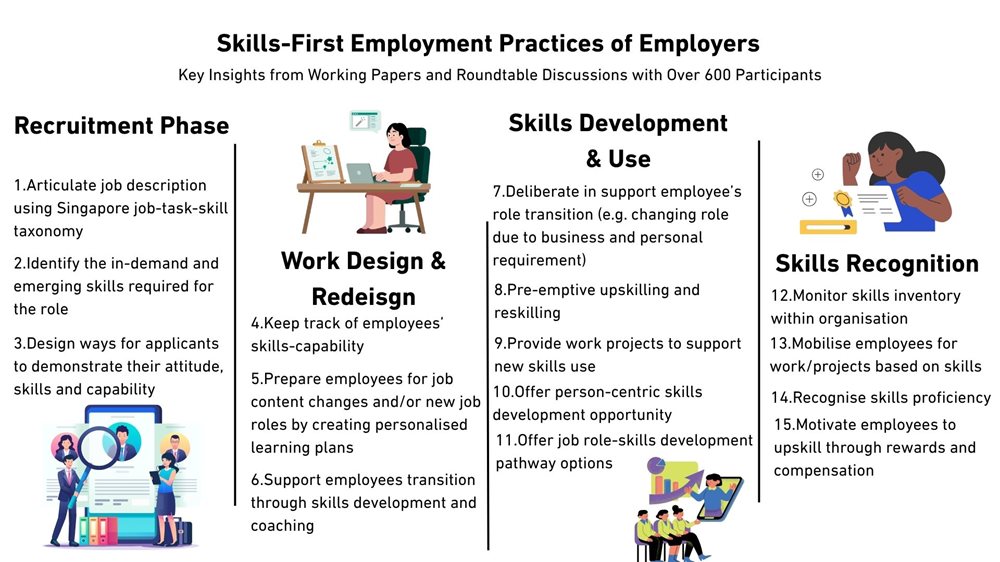
Together, national infrastructure and ecosystem support create the conditions for skills-first adoption. The next challenge is execution: embedding these practices into everyday HR decisions at scale. This is where HR technologies play a pivotal role. The growing landscape of HR apps and tools provides the operational backbone for translating skills-first principles into hiring, development, and workforce management.
HR Tools as Enablers of Skills-First Practices
As organisations move from strategy to execution, a critical but often overlooked layer is the growing landscape of HR apps and tools, which enable skills-first practices to be embedded into everyday workforce decisions. While organisations today have access to thousands of digital solutions, many struggle to determine which tools to adopt, how they support HR functions, and how they contribute to skills-first outcomes.
To address this, the CSFP, in collaboration with the Institute for Human Resource Professionals (IHRP), conducted the Understanding the HR Toolscape study. The study analysed tools used by HR practitioners and organised them into a structured construct frame, mapping each tool’s features to HR functions and competency domains. This allows organisations to move beyond ad hoc tool adoption towards a more deliberate, capability-aligned approach.
The analysis shows that tool adoption today remains uneven. Organisations tend to invest more heavily in tools that support planning, operations, and engagement, while areas such as sustainability and end-of-employment processes remain less digitally enabled. At the same time, many existing tools already contain functionalities that can support skills-first practices, particularly in recruitment and skills development, though fewer integrate across the full talent lifecycle.
These insights highlight that the opportunity is not just to adopt more tools, but to use existing tools more strategically ensuring tool alignment with redesigned work, skills requirements, and workforce outcomes.
Making skills-first real
Skills-first is ultimately about sustaining alignment between work, human capability, and value creation as technology reshapes the economy. Technology will continue to change tasks faster than job titles, qualifications, and HR processes can adapt. The organisations that respond well will be those that treat this as an integrated shift: redesign work around new workflows, make skills visible and verifiable, and hardwire skills into hiring, development, progression, and mobility.
Done properly, skills-first is not just a way to fill vacancies. It is a way to unlock potential, reduce mismatch, and build a workforce that can move as demand shifts. With national signals like the SDFE report and adoption support through CSFP, Singapore is also strengthening the shared infrastructure that helps firms and workers navigate change. The remaining challenge is execution: turning these tools and insights into everyday decisions that reward capability, support transitions, and ensure that productivity gains translate into better jobs and sustainable competitiveness.
For employers, talent matching is harder than ever. What is driving this mismatch is not simply a shortage of talent. It is that technology, especially AI, is rapidly changing the mix of tasks within roles. This widening skills gap is affecting employers’ hiring confidence. In Singapore, a 2025–2026 survey found that only 23.2% of hiring managers felt confident about finding qualified local talent, while 65.1% cited skills mismatch as a key hiring challenge. Another survey reports that 77% of employers in the Asia Pacific region struggle to find skilled talent.
Technology changes tasks. Work redesign reorganises work. Skills-first makes it actionable.
Technology and AI disruption, work redesign, and skills-first practices form a connected chain—but not in a purely technology-driven sequence. The process begins with how work is understood and reorganised.
Technology changes tasks by enabling automation, augmentation, and new ways of performing work. For example, with an AI assistant, a customer service officer spends less time on routine queries and ticket logging, as the system can draft responses, retrieve policy information, and suggest next steps. This shifts the task mix of the role, increasing the relative importance of handling complex cases that require judgement, communication, and contextual understanding. The job may retain the same title, but the underlying task composition — and therefore the capabilities required — changes significantly.
Work redesign is the organisational response, but it does not begin with technology. It starts by identifying the business challenges and clarifying how value is created, and then systematically deconstructing work into tasks and skills, identifying inefficiencies and low-value activities. Only then are decisions made about which tasks should be automated, augmented, or retained by humans. Work is subsequently reconstructed into redesigned roles, workflows, and team structures that better reflect an AI-enabled operating model — one that makes explicit where human judgement, relational capability, and contextual reasoning remain essential, and where technology can reliably support or replace effort.
Skills-first practices then make this redesign operational. By translating redesigned work into clear, task- and skill-based capability requirements, organisations can hire more accurately, target development effectively, and enable mobility across roles. This allows workers to be redeployed and reskilled in line with evolving work demands, while supporting progression based on demonstrated capabilities rather than static job titles. In turn, this strengthens productivity, improves job quality, and aligns workforce development with organisational strategy.
The shift in talent management
Turning redesigned work into real capability requires enterprises to rebuild the talent systems that decide who gets hired, developed, and moved.
This begins by translating technological disruption into deliberate work redesign. Rather than defaulting to automation or outsourcing, organisations first deconstruct work into tasks and skills, then assess which tasks can be automated, which can be augmented by technology, and which should be reallocated or elevated to focus on higher-value, judgement-intensive activities. The goal is to rebalance work so that human effort is concentrated where it contributes most to value creation, while technology reduces friction in routine or lower-value tasks. The experience of local manufacturer Cragar Industries illustrates the payoff: through work redesign, it cut its time spent on financial processes from 48.5 hours per cycle to just over 18 hours, freeing up capacity for more analytical and decision-support work for the worker.
Next, enterprises need to a stronger skills architecture to anchor workforce planning. Enterprises should shift toward skill-based deployment, mapping critical skills to workflows, identifying adjacencies, and planning talent supply based on the capabilities the business needs.
Third, skills-first only scales when companies realign talent systems. Hiring, performance, rewards, and mobility must reinforce redesigned roles. This includes hiring for transferable skills and learning agility, evaluating people on outcomes and skill use, and creating internal pathways where movement is normal. Telecommunications company Singtel, for example, promotes an “internal-first” hiring mindset and encourages employees to apply for internal roles at any grade, with no minimum tenure required.
Finally, enterprises must support transition with intent: reskilling, redeployment, and clear communication about what is changing, why, and what support exists.
The results of such an approach are tangible. Heritage jeweller On Cheong Jewellery improved employee retention by 20% and strengthened internal mobility after formalising its onboarding and training. Each employee receives 60 hours of training annually, supported by personalised learning roadmaps. It also widened its hiring pool to candidates from adjacent sectors such as hospitality, prioritising transferable skills like service excellence. AI start-up Nudgyt has linked sustained upskilling and reskilling to a 20% productivity lift and a 15% improvement in overall work performance.
Beyond systems and structures, skills-first must be reflected in day-to-day employer behaviours that shape how work is assigned, performance is evaluated, and people are developed.
Tapping on National Infrastructure to Scale Skills-First
For skills-first practices to scale, enterprise-level transformation remains central, but companies can tap on national labour-market infrastructure that provides timely signals on where demand is shifting, and practical support to translate those signals into hiring, work redesign, and capability development.
In Singapore, this support is provided through several initiatives, including the following:
First, SkillsFuture Singapore’s Skills Demand for the Future Economy (SDFE) report strengthens the “common picture” of jobs and skills demand. Launched in 2021 and updated in subsequent editions, the report provides jobs-and-skills insights to help individuals, employers, and training providers make more informed decisions and improve coordination between skills supply and industry demand. Complementing this, the Jobs-Skills portal offers datasets, dashboards, and analytical tools that organisations can use to align workforce planning with emerging demand.
Second, the Centre for Skills-First Practices (CSFP), launched by IAL in 2025, focuses on adoption. Its role is to build ecosystem capability and enable stakeholders (employers, training providers, unions, and policymakers) to identify, develop, activate, and recognise skills as core to competitiveness, so skills-first moves from concept to practice on the ground. Through programmes and practical tools—including courses that help stakeholders interpret and apply jobs-skills insights—CSFP helps translate data into actionable workforce strategies.
Together, national infrastructure and ecosystem support create the conditions for skills-first adoption. The next challenge is execution: embedding these practices into everyday HR decisions at scale. This is where HR technologies play a pivotal role. The growing landscape of HR apps and tools provides the operational backbone for translating skills-first principles into hiring, development, and workforce management.
HR Tools as Enablers of Skills-First Practices
As organisations move from strategy to execution, a critical but often overlooked layer is the growing landscape of HR apps and tools, which enable skills-first practices to be embedded into everyday workforce decisions. While organisations today have access to thousands of digital solutions, many struggle to determine which tools to adopt, how they support HR functions, and how they contribute to skills-first outcomes.
To address this, the CSFP, in collaboration with the Institute for Human Resource Professionals (IHRP), conducted the Understanding the HR Toolscape study. The study analysed tools used by HR practitioners and organised them into a structured construct frame, mapping each tool’s features to HR functions and competency domains. This allows organisations to move beyond ad hoc tool adoption towards a more deliberate, capability-aligned approach.
The analysis shows that tool adoption today remains uneven. Organisations tend to invest more heavily in tools that support planning, operations, and engagement, while areas such as sustainability and end-of-employment processes remain less digitally enabled. At the same time, many existing tools already contain functionalities that can support skills-first practices, particularly in recruitment and skills development, though fewer integrate across the full talent lifecycle.
These insights highlight that the opportunity is not just to adopt more tools, but to use existing tools more strategically ensuring tool alignment with redesigned work, skills requirements, and workforce outcomes.
Making skills-first real
Skills-first is ultimately about sustaining alignment between work, human capability, and value creation as technology reshapes the economy. Technology will continue to change tasks faster than job titles, qualifications, and HR processes can adapt. The organisations that respond well will be those that treat this as an integrated shift: redesign work around new workflows, make skills visible and verifiable, and hardwire skills into hiring, development, progression, and mobility.
Done properly, skills-first is not just a way to fill vacancies. It is a way to unlock potential, reduce mismatch, and build a workforce that can move as demand shifts. With national signals like the SDFE report and adoption support through CSFP, Singapore is also strengthening the shared infrastructure that helps firms and workers navigate change. The remaining challenge is execution: turning these tools and insights into everyday decisions that reward capability, support transitions, and ensure that productivity gains translate into better jobs and sustainable competitiveness.
To explore how HR tools can be systematically mapped to workforce capabilities and skills-first practices, read the full report – Understanding the HR Toolscape: A Construct Frame of Applications and Tools.