 Back
Back

What if talent is not rare but cultivable? What if innovation is not a department but a way of working? What if learning is not a one-off intervention but a lasting capability woven into the fabric of daily business life?
These questions are becoming more urgent as Singapore enterprises face shifting employee expectations, rapid technological change, and a workforce seeking more meaningful development opportunities. In a landscape where agility and creativity are key, Singapore’s small and medium enterprises (SMEs) must answer these questions to innovate and achieve sustained competitiveness in an ever-changing economy.
Over at IAL, a growing body of research is challenging long-held assumptions about focusing on selected talent. Instead, organisations can unlock growth potential and capability by reimagining how they nurture talent, shape work, and invest in their people enterprise-wide. Each time a team member is empowered to learn and grow, or entrusted with a new task, the enterprise’s value proposition evolves. Meaningful transformation takes root when talent inclusivity is woven into the rhythm of daily work.
A Surprising Discovery
“We didn’t set out to study innovation,” says Dr Sahara Sadik, Deputy Director of the Research Division at IAL. “We stumbled on it. Our starting point was a different question: why do we still talk about a lack of talent in a country with such high human capital?”
The real issue was not the individuals, but how organisations defined and developed talent. Firms that restricted high potential to the top 10–20% of staff tended to favour top-down, controlled innovation, what Dr Sadik calls “predictable innovation”. However, companies that took a more inclusive approach to talent, investing in a broader base of employees, saw a different kind of innovation emerge: more distributed, more adaptive, and ultimately, more valuable.
“It turns out,” she notes, “how you define talent is also how you innovate.”
Rethinking ‘High Potential’
The deeper the research went, the more the old logic of talent management began to unravel.
“We were looking for social outcomes and we found economic performance too,” Dr Sadik explains.
“We thought inclusive talent practices were a moral or social choice. But it turns out they’re also good for business.”
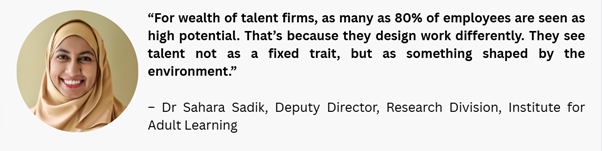
Inclusive firms, i.e. those that cast the net wider when it came to talent, were more likely to report growth in profitability, revenue, and market share. More critically, the more they decentralised the definition of “high potential,” the more resilient and creative they became.
Perhaps most eye-opening of all was just how arbitrary the “top 10–20%” label could be. In many firms, no one could clearly explain who made the cut or why.
These questions are becoming more urgent as Singapore enterprises face shifting employee expectations, rapid technological change, and a workforce seeking more meaningful development opportunities. In a landscape where agility and creativity are key, Singapore’s small and medium enterprises (SMEs) must answer these questions to innovate and achieve sustained competitiveness in an ever-changing economy.
Over at IAL, a growing body of research is challenging long-held assumptions about focusing on selected talent. Instead, organisations can unlock growth potential and capability by reimagining how they nurture talent, shape work, and invest in their people enterprise-wide. Each time a team member is empowered to learn and grow, or entrusted with a new task, the enterprise’s value proposition evolves. Meaningful transformation takes root when talent inclusivity is woven into the rhythm of daily work.
A Surprising Discovery
“We didn’t set out to study innovation,” says Dr Sahara Sadik, Deputy Director of the Research Division at IAL. “We stumbled on it. Our starting point was a different question: why do we still talk about a lack of talent in a country with such high human capital?”
The real issue was not the individuals, but how organisations defined and developed talent. Firms that restricted high potential to the top 10–20% of staff tended to favour top-down, controlled innovation, what Dr Sadik calls “predictable innovation”. However, companies that took a more inclusive approach to talent, investing in a broader base of employees, saw a different kind of innovation emerge: more distributed, more adaptive, and ultimately, more valuable.
“It turns out,” she notes, “how you define talent is also how you innovate.”
Rethinking ‘High Potential’
The deeper the research went, the more the old logic of talent management began to unravel.
“We were looking for social outcomes and we found economic performance too,” Dr Sadik explains.
“We thought inclusive talent practices were a moral or social choice. But it turns out they’re also good for business.”
Inclusive firms, i.e. those that cast the net wider when it came to talent, were more likely to report growth in profitability, revenue, and market share. More critically, the more they decentralised the definition of “high potential,” the more resilient and creative they became.
Perhaps most eye-opening of all was just how arbitrary the “top 10–20%” label could be. In many firms, no one could clearly explain who made the cut or why.
From Scarcity to Strategy
For SMEs, the implications are profound. Talent scarcity is often seen as a resource issue. Many SMEs do not have dedicated HR departments, face time constraints when it comes to training, and lack funds for expensive hires. But IAL’s research suggests the real question is more fundamental: what kind of business do you want to be?
“The moment an SME decides to compete on value, not just price, it opens the door to a different way of organising work,” says Dr Sadik. “Yes, it’s more demanding, but SMEs that took this path reported stronger customer ties, more cutting-edge products, and ultimately — better performance.”
With this perspective, talent development is no longer just an HR initiative but a business strategy.
Beyond the Stars
Changing this mindset starts with one of the most pervasive myths in corporate life: that talent is rare, and only the best should be developed.
“If you only bet on stars, you miss the constellation,” says Dr Sadik.
While some HR leaders continue to believe that elite-focused strategies deliver superior business results, the data tells a different story. Firms that invested in broader capability-building, not just leadership development, performed better across the board. However, shifting the paradigm, which involves changing organisational culture, leadership expectations, and legacy practices, is a challenging act.
To this group, Dr Sadik has this advice, “Use the evidence. Start small. Partner with team leaders who want to work differently. Build internal coalitions. Change won’t happen overnight, but it starts with someone showing what’s possible.”
Learning as Innovation
Central to this new approach is how learning is viewed. In a wealth of talent organisation, learning is not something that happens in a classroom or workshop. It is the work.
“These firms depend on generative learning,” Dr Sadik explains. “Employees are not just absorbing knowledge. They are co-creating it, in real time, with colleagues and customers. Learning becomes the engine of innovation.”
Adult educators and learning professionals have a critical role to play, not just by designing better programmes, but by changing how organisations view capability and potential.
This means positioning learning as a strategic lever, one that helps frontline teams solve problems, spot opportunities, and act with initiative. It means embedding coaching and peer learning into everyday workflows, helping firms recognise that innovation is not confined to labs or leadership but in the hands of employees who are trusted to make decisions, try new things, and learn from the outcomes.
Creating Room to Move
One of the most overlooked aspects of innovation is something many Singapore workplaces struggle with: task discretion.
“Discretion is key — but it’s poorly understood in Singapore,” Dr Sadik notes. “Our work tends to be tightly scripted, execution-focused, and risk-averse. But when people have room to move, they find ways to grow.”
Wealth of talent firms redesign roles to allow for high discretion and high complexity, especially on the front lines. Initiative is expected, not penalised. Reward systems are calibrated to recognise those who try, even when they don’t succeed.
“People take risks when they trust the system,” Dr Sadik explains. “So, we need to design systems that reward experimentation.”
Coaching for the Many, Not Just the Few
One of the clearest markers of a wealth of talent organisation is how it approaches coaching.
In traditional “war for talent” firms, coaching is selective, reserved for the top tier. But in inclusive firms, coaching is systemic.
Team leaders become capability builders. Peer learning is structured into workflows. Coaching is no longer a privilege but a shared responsibility.
“Everyone is expected to grow and to help others grow,” Dr Sadik explains. “It’s not just for more people get developed, it’s for people development to become part of the workplace culture.”
The talent is there. You just have to unlock it.
For SMEs, the implications are profound. Talent scarcity is often seen as a resource issue. Many SMEs do not have dedicated HR departments, face time constraints when it comes to training, and lack funds for expensive hires. But IAL’s research suggests the real question is more fundamental: what kind of business do you want to be?
“The moment an SME decides to compete on value, not just price, it opens the door to a different way of organising work,” says Dr Sadik. “Yes, it’s more demanding, but SMEs that took this path reported stronger customer ties, more cutting-edge products, and ultimately — better performance.”
With this perspective, talent development is no longer just an HR initiative but a business strategy.
Beyond the Stars
Changing this mindset starts with one of the most pervasive myths in corporate life: that talent is rare, and only the best should be developed.
“If you only bet on stars, you miss the constellation,” says Dr Sadik.
While some HR leaders continue to believe that elite-focused strategies deliver superior business results, the data tells a different story. Firms that invested in broader capability-building, not just leadership development, performed better across the board. However, shifting the paradigm, which involves changing organisational culture, leadership expectations, and legacy practices, is a challenging act.
To this group, Dr Sadik has this advice, “Use the evidence. Start small. Partner with team leaders who want to work differently. Build internal coalitions. Change won’t happen overnight, but it starts with someone showing what’s possible.”
Learning as Innovation
Central to this new approach is how learning is viewed. In a wealth of talent organisation, learning is not something that happens in a classroom or workshop. It is the work.
“These firms depend on generative learning,” Dr Sadik explains. “Employees are not just absorbing knowledge. They are co-creating it, in real time, with colleagues and customers. Learning becomes the engine of innovation.”
Adult educators and learning professionals have a critical role to play, not just by designing better programmes, but by changing how organisations view capability and potential.
This means positioning learning as a strategic lever, one that helps frontline teams solve problems, spot opportunities, and act with initiative. It means embedding coaching and peer learning into everyday workflows, helping firms recognise that innovation is not confined to labs or leadership but in the hands of employees who are trusted to make decisions, try new things, and learn from the outcomes.
Creating Room to Move
One of the most overlooked aspects of innovation is something many Singapore workplaces struggle with: task discretion.
“Discretion is key — but it’s poorly understood in Singapore,” Dr Sadik notes. “Our work tends to be tightly scripted, execution-focused, and risk-averse. But when people have room to move, they find ways to grow.”
Wealth of talent firms redesign roles to allow for high discretion and high complexity, especially on the front lines. Initiative is expected, not penalised. Reward systems are calibrated to recognise those who try, even when they don’t succeed.
“People take risks when they trust the system,” Dr Sadik explains. “So, we need to design systems that reward experimentation.”
Coaching for the Many, Not Just the Few
One of the clearest markers of a wealth of talent organisation is how it approaches coaching.
In traditional “war for talent” firms, coaching is selective, reserved for the top tier. But in inclusive firms, coaching is systemic.
Team leaders become capability builders. Peer learning is structured into workflows. Coaching is no longer a privilege but a shared responsibility.
“Everyone is expected to grow and to help others grow,” Dr Sadik explains. “It’s not just for more people get developed, it’s for people development to become part of the workplace culture.”
The talent is there. You just have to unlock it.
Click here to read more on IAL's research insights on Singapore's 'wealth of talent' firms.