 Back
Back
In today’s economy, change is constant, layered, and often unpredictable. “Enterprises today are navigating AI adoption, tighter margins and rapidly changing customer expectations – often all at once,” IAL Executive Director Associate Professor (Practice) Terence Ho observed. “In this environment, investment in training has to be more strategic in meeting business needs.”
The convergence of pressures, from rapid technological shifts to geopolitical volatility impacting supply chains, has reshaped the labour market. Skills that were relevant just a few years ago are becoming outdated, while new ones are emerging just as quickly.
Reskilling and upskilling are no longer routine corporate activities. As skill cycles shorten, learning must be continuous, strategic, and closely tied to business performance. This need for applied, work-integrated learning sits at the heart of IAL’s Learning Enterprise Alliance (LEA) initiative.
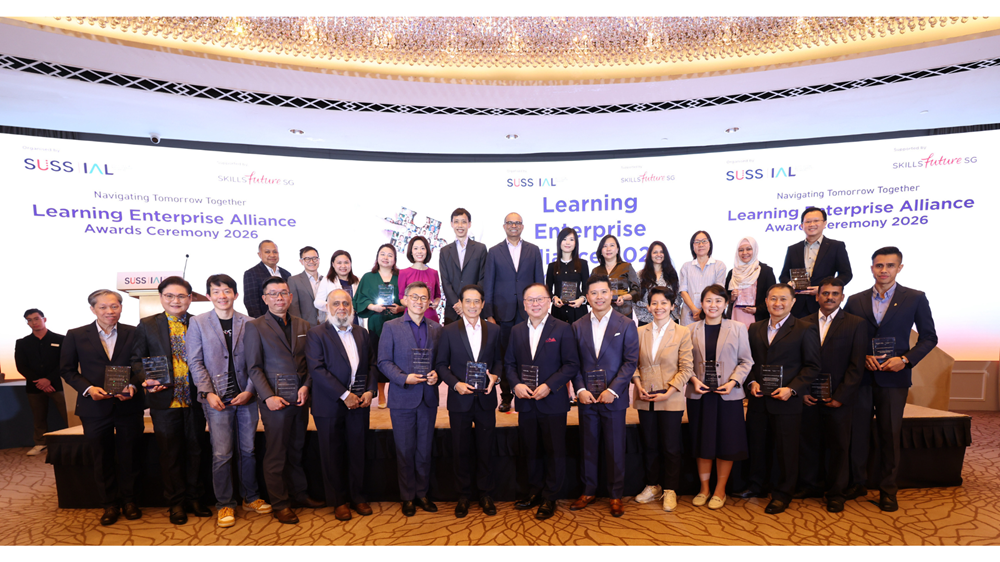
Launched in 2018, LEA set out to do something simple but ambitious: bring organisations together to learn from one another and embed workplace learning more deeply into business. At this year’s LEA Awards Ceremony, held on 10 April 2026, another 28 organisations were recognised for their commitment to building capabilities through workplace learning, bringing the network to over 180 members.
Navigating tomorrow together
The theme for this year’s awards, “Navigating Tomorrow Together”, captures both the challenge and response. In an era defined by volatility and black swan events. no single actor can navigate this alone. Enterprises, policymakers, training providers and the workforce must work as an ecosystem, pooling knowledge and practice to turn human capital into a sustained competitive advantage.
Graced by Senior Minister of State for Education & Sustainability and the Environment Dr Janil Puthucheary, the event recognises a growing shift in how capability building is understood.
“When employers invest in employees’ training, employees become more productive, they become more innovative, and become more resilient. This then helps our companies remain competitive and relevant amidst rapid changes,” Dr Puthucheary emphasised. This principle applies not just to big companies, but to boutique outfits as well, as award winner Rumah Kim Choo proves.
A small outfit, a big lesson
The convergence of pressures, from rapid technological shifts to geopolitical volatility impacting supply chains, has reshaped the labour market. Skills that were relevant just a few years ago are becoming outdated, while new ones are emerging just as quickly.
Reskilling and upskilling are no longer routine corporate activities. As skill cycles shorten, learning must be continuous, strategic, and closely tied to business performance. This need for applied, work-integrated learning sits at the heart of IAL’s Learning Enterprise Alliance (LEA) initiative.
Launched in 2018, LEA set out to do something simple but ambitious: bring organisations together to learn from one another and embed workplace learning more deeply into business. At this year’s LEA Awards Ceremony, held on 10 April 2026, another 28 organisations were recognised for their commitment to building capabilities through workplace learning, bringing the network to over 180 members.
Navigating tomorrow together
The theme for this year’s awards, “Navigating Tomorrow Together”, captures both the challenge and response. In an era defined by volatility and black swan events. no single actor can navigate this alone. Enterprises, policymakers, training providers and the workforce must work as an ecosystem, pooling knowledge and practice to turn human capital into a sustained competitive advantage.
Graced by Senior Minister of State for Education & Sustainability and the Environment Dr Janil Puthucheary, the event recognises a growing shift in how capability building is understood.
“When employers invest in employees’ training, employees become more productive, they become more innovative, and become more resilient. This then helps our companies remain competitive and relevant amidst rapid changes,” Dr Puthucheary emphasised. This principle applies not just to big companies, but to boutique outfits as well, as award winner Rumah Kim Choo proves.
A small outfit, a big lesson
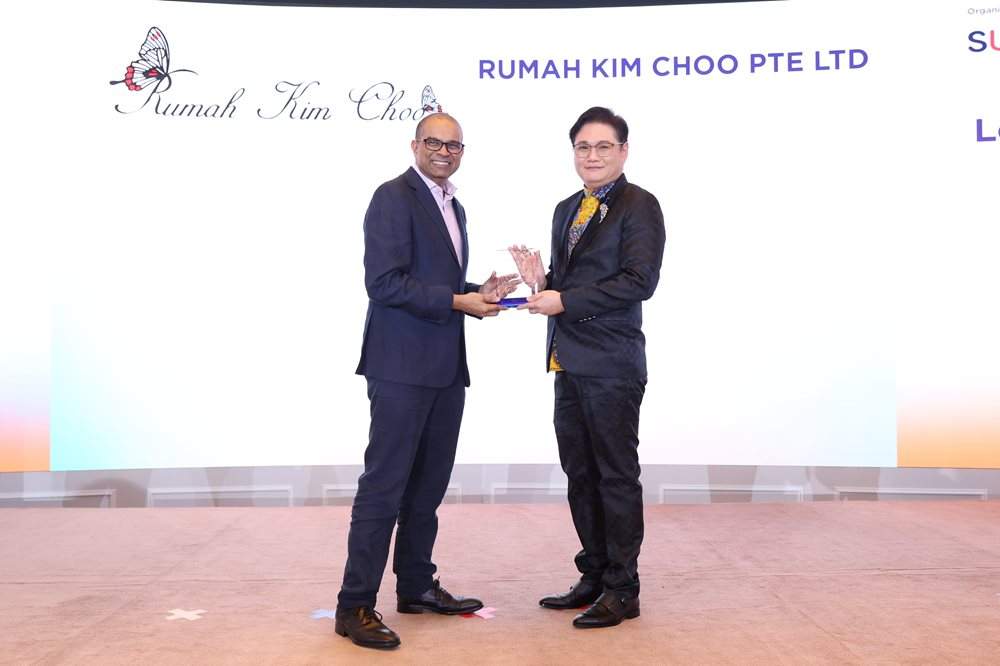
Mr Raymond Wong (right), director of Rumah Kim Choo, receiving the LEA award from SMS Janil Puthucheary.
At first glance, it is an unlikely example of workplace learning in action. With a small team of just 10, the business specialises in handcrafted kebayas (traditional Peranakan costume) and cultural products.
But its challenges are familiar to many SMEs. As interest in Peranakan culture surged, driven by UNESCO recognition, media exposure, and growing consumer demand, the company faced a critical question: how to scale without diluting its identity.
The answer lay not in producing more, but in rethinking what its people could do. “I need my employees to become more than retail associates,” explained director Raymond Wong. “We wanted them to embody the craft as artisans, storytellers, and cultural ambassadors who carry the pride and spirit of the Nyonya Kebaya.”
This pivoting required new capabilities such as storytelling, cultural interpretation, and facilitation, which did not previously exist within the team. Through a LEA project with IAL, Rumah Kim Choo redesigned roles, developed structured training, and embedded learning into daily work.
But its challenges are familiar to many SMEs. As interest in Peranakan culture surged, driven by UNESCO recognition, media exposure, and growing consumer demand, the company faced a critical question: how to scale without diluting its identity.
The answer lay not in producing more, but in rethinking what its people could do. “I need my employees to become more than retail associates,” explained director Raymond Wong. “We wanted them to embody the craft as artisans, storytellers, and cultural ambassadors who carry the pride and spirit of the Nyonya Kebaya.”
This pivoting required new capabilities such as storytelling, cultural interpretation, and facilitation, which did not previously exist within the team. Through a LEA project with IAL, Rumah Kim Choo redesigned roles, developed structured training, and embedded learning into daily work.
“The project has helped us embarked on people development. The IAL consultant also ensured that all learning is work-related and delivered real business results,” Director Mr Raymond Wong shared.
The results were clear: more confident staff, new revenue from SG Culture Pass workshops, and learning embedded at the core of the business. More importantly, Rumah Kim Choo shows that capability building can be a competitive edge, even for small firms.
Singapore has made significant progress in workforce development. Workplace learning participation stands at 89%, a strong figure by most measures.
Yet the data also reveals gaps. Participation is not yet universal, and disparities remain between different groups of workers. While 97% of professionals, managers, and technicians (PMETs) engage in workplace learning, the figure drops to 71% among non-PMETs.
There is also a question of intensity. In countries like Switzerland and the United States, nearly half of workers engage in workplace learning weekly. In Singapore, only about one in three do so.
This is where LEA comes in. “Each enterprise brings operational realities; each practitioner brings professional expertise; IAL provides proven practices and solutions,” said Associate Professor Mr Ho. “If we sustain this collaboration, workplace learning in Singapore will become more embedded, more meaningful, and more impactful.”
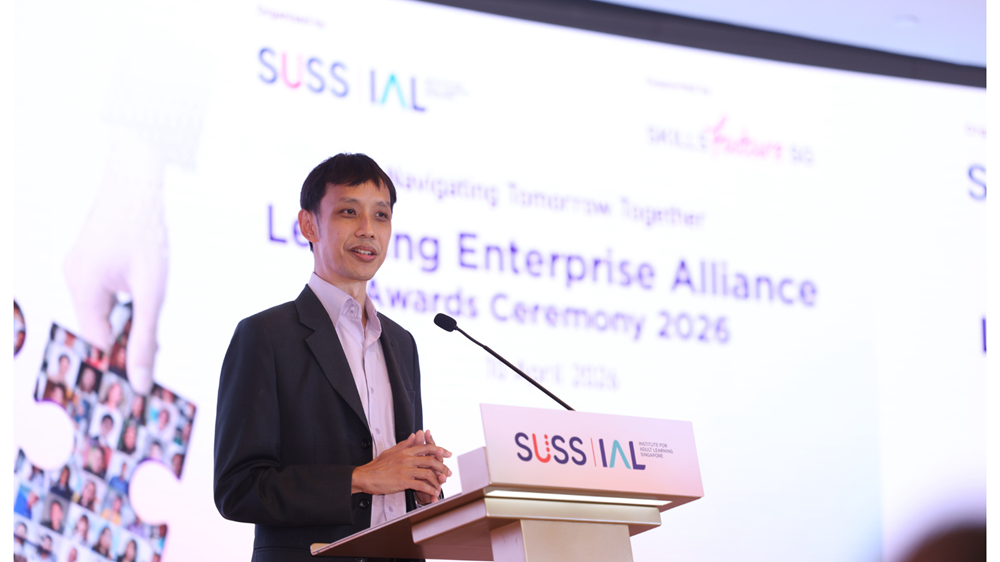
Assoc Prof (Practice) Terence Ho urges enterprise leaders to invest in training as a strategic direction to improve business outcomes.
To push workplace learning further, IAL also unveiled a new Learning Enterprise Framework (LEF), designed to help organisations uncover what is really holding back business performance and how learning can address it.
The framework responds to a familiar frustration. Many companies invest in training, yet see limited impact on business outcomes. The issue, more often than not, is not a lack of skills, but deeper misalignments in how work is organised, supported and led to realise business outcomes.
Rather than treating learning as a standalone activity, the LEF reframes it as part of a broader system. Supported by a 48-item diagnostic tool, the framework looks at four interconnected areas to surface where gaps may lie: leadership, knowledge and learning, systems and processes, and alignment.
The framework also reflects how learning itself is evolving, incorporating digital and AI-enabled approaches such as in-app guidance, knowledge sharing and collaboration platforms, and work-integrated learning.
IAL will begin rolling out the framework through pilot engagements, with the aim of helping organisations embed learning into everyday work.
From routine activity to business advantage
Learning is no longer a routine or support function. Gobally, enterprises increasingly find that strategic, relevant learning is becoming a core business capability that shapes how organisations innovate, adapt, and compete. It is what enables organisations to move from reacting to change, to shaping and pre-empting change.
As Associate Professor Ho summed up, “When learning is embedded into daily work, and performance and purpose shape how resources are allocated, it moves beyond activity and begins to drive performance.”