 Back
Back

As artificial intelligence (AI) transforms how we work and live, Singapore faces a deeper learning challenge — not of skills supply, but whether we are learning deeply enough to adapt, apply knowledge and create value in changing work context.
Less than 1 in 3 workers in Singapore are deep learners
Even before gen AI was widely used, nationally representative findings from the Institute for Adult Learning’s (IAL) revealed that less than one in three workers in Singapore are “deep learners”. Deep learners actively make sense of new ideas, connect them to what they already know, and apply them meaningfully in different contexts. In contrast, some learners report less frequent use of deeper learning strategies, such as sense-making, reflection and application across contexts.
“This distinction matters more than we might think,” says Sheng Yee Zher, Principal Researcher, IAL. “As machines become better at processing vast amounts of data, our human edge lies in the ability to think critically, make connections, and adapt knowledge creatively. In short, deep learning involves sense-making: making meaning from what we learn, connecting ideas, and applying knowledge wisely."
The Value of Learning Deeply
Deep learning is not simply about taking courses or earning certificates. It is the foundation of adaptive performance in an AI age. Where machines can increasingly analyse information and automate tasks, humans needs to showcase their value by differentiating themselves through insight, synthesis and application of knowledge.
However, SLS2 suggests that while job requirements and work environments can motivate individuals to learn, deep learning is shaped by more than external demands alone. It also depends on learners’ learning orientations which include motivation to learn and drive for skills mastery.
The study shows that deep learners are more internally driven to learn and possess a stronger drive for skills mastery. They are more likely see learning as a continuous and self-directed process, rather than something that is required of them. This orientation helps to sustain their performance and spark innovation. Deep learners are also significantly more likely to transfer what they learn to the workplace, across different contexts and to engage actively in their communities.
Such active application of knowledge not only brings about workplace improvement, it also benefits their career development, especially as workers face changing job demands in an AI-enabled economy.
Less than 1 in 3 workers in Singapore are deep learners
Even before gen AI was widely used, nationally representative findings from the Institute for Adult Learning’s (IAL) revealed that less than one in three workers in Singapore are “deep learners”. Deep learners actively make sense of new ideas, connect them to what they already know, and apply them meaningfully in different contexts. In contrast, some learners report less frequent use of deeper learning strategies, such as sense-making, reflection and application across contexts.
“This distinction matters more than we might think,” says Sheng Yee Zher, Principal Researcher, IAL. “As machines become better at processing vast amounts of data, our human edge lies in the ability to think critically, make connections, and adapt knowledge creatively. In short, deep learning involves sense-making: making meaning from what we learn, connecting ideas, and applying knowledge wisely."
The Value of Learning Deeply
Deep learning is not simply about taking courses or earning certificates. It is the foundation of adaptive performance in an AI age. Where machines can increasingly analyse information and automate tasks, humans needs to showcase their value by differentiating themselves through insight, synthesis and application of knowledge.
However, SLS2 suggests that while job requirements and work environments can motivate individuals to learn, deep learning is shaped by more than external demands alone. It also depends on learners’ learning orientations which include motivation to learn and drive for skills mastery.
The study shows that deep learners are more internally driven to learn and possess a stronger drive for skills mastery. They are more likely see learning as a continuous and self-directed process, rather than something that is required of them. This orientation helps to sustain their performance and spark innovation. Deep learners are also significantly more likely to transfer what they learn to the workplace, across different contexts and to engage actively in their communities.
Such active application of knowledge not only brings about workplace improvement, it also benefits their career development, especially as workers face changing job demands in an AI-enabled economy.
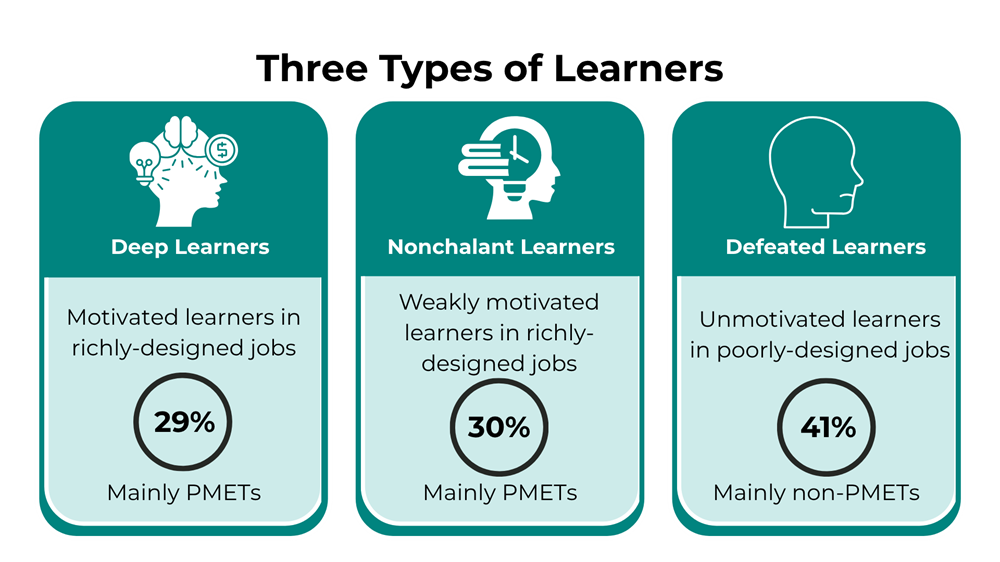
Conversely, defeated learners are less likely to see value in applying what they have learnt beyond their immediate scope of work. They are also less confident that they have the capability to do so.
About two in five workers in Singapore belongs to this defeated learner group. They tend to be in jobs with fewer opportunities for rich learning, autonomy and decision-making. They also report weaker career confidence and prospects with limited career advancement opportunities.
The other 30 per cent fall into the nonchalant learners group. These learners are not as disengaged as defeated learners, but their motivation is moderate despite being in relatively richer jobs. This suggests that access to better job-learning conditions alone may not be sufficient; some workers may also need support to build stronger motivation, confidence and purpose in learning.
Unlocking motivation in the workplace
The findings highlight a crucial point: access to training alone does not guarantee deep learning, which in turn infers that equal access to training does not translate into equal outcomes.
What then can Singapore do, to swiftly unlock the collective motivation, mastery and mindset and become a nation of deep learners who are able to confront the AI challenge?
The key may lie in establishing the right workplace learning environment.
While motivation is internal, SLS2 finds that a supportive workplace environment that supports learning can catalyse ones motivation, moving even the uninitiated. Even among less motivated learners, the right job conditions can make a difference.
In workplaces where employees are encouraged to apply what they learn, experiment, and support others’ growth, motivation to learn increases by nearly 50 per cent, and skills mastery by a similar margin.Such environments do not just enable learning, they ignite the internal drive and confidence that sustain deep learning over time.
This reinforces the idea that learning extends beyond classrooms. Some of the most impactful learning happens through problem-solving, collaboration and reflection in daily work.
What employers can do
While many organisations have regularly expressed challenges in manpower constraints to meet operational needs, limiting their ability to allow for protected training time, embedding learning in routine work might be something more practical.
Employers who create the conditions to give employees room to think, decide and contribute are, in effect, building learning-enabled workplaces — where their people grow as they go about their daily work.
This should be the learning work culture enterprises strive for, as learning employees will ultimately translate into higher adaptability, innovation and long-term success for the businesses. The positive learning culture might also foster a sense of agency and meaning in work, leading to greater sense of job satisfaction, belonging and lower attrition.
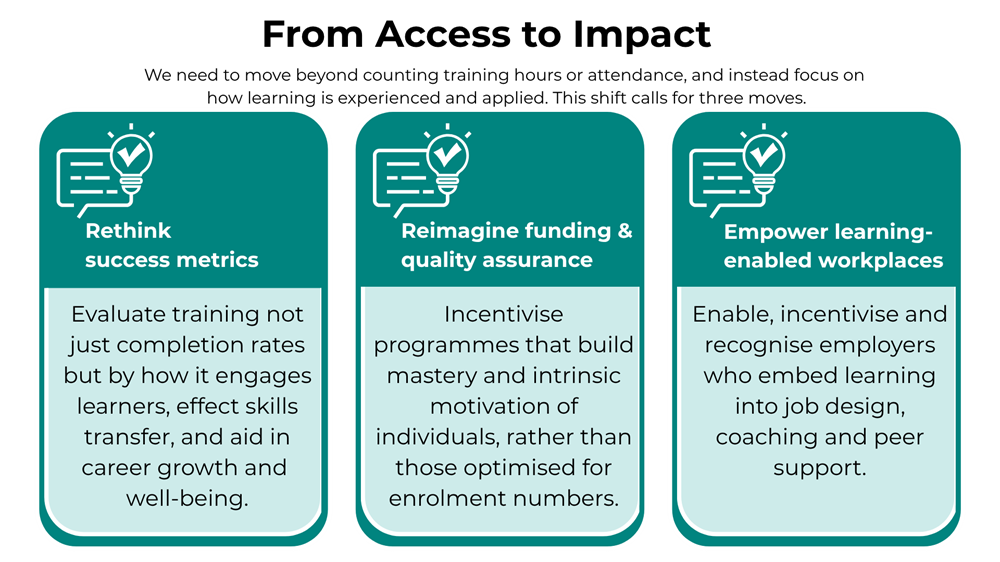
Towards a Culture of Deep Learning
Ultimately, becoming a nation of deep learners requires more than policies — it calls for a cultural shift in how we value, support and practice learning.
In an age where AI can process information rapidly, our human edge lies not in knowing more, but in thinking critically, connecting and creating. Deep learners are reflective, adaptable and purpose-driven. They make sense of complexity, and apply knowledge to create value.
If Singapore is to thrive in the AI age, we must nurture this habit of mind—across schools, workplaces and communities.
The challenge is clear: to become not just a nation that learns, but a nation that learns deeply.
About two in five workers in Singapore belongs to this defeated learner group. They tend to be in jobs with fewer opportunities for rich learning, autonomy and decision-making. They also report weaker career confidence and prospects with limited career advancement opportunities.
The other 30 per cent fall into the nonchalant learners group. These learners are not as disengaged as defeated learners, but their motivation is moderate despite being in relatively richer jobs. This suggests that access to better job-learning conditions alone may not be sufficient; some workers may also need support to build stronger motivation, confidence and purpose in learning.
Unlocking motivation in the workplace
The findings highlight a crucial point: access to training alone does not guarantee deep learning, which in turn infers that equal access to training does not translate into equal outcomes.
What then can Singapore do, to swiftly unlock the collective motivation, mastery and mindset and become a nation of deep learners who are able to confront the AI challenge?
The key may lie in establishing the right workplace learning environment.
While motivation is internal, SLS2 finds that a supportive workplace environment that supports learning can catalyse ones motivation, moving even the uninitiated. Even among less motivated learners, the right job conditions can make a difference.
In workplaces where employees are encouraged to apply what they learn, experiment, and support others’ growth, motivation to learn increases by nearly 50 per cent, and skills mastery by a similar margin.Such environments do not just enable learning, they ignite the internal drive and confidence that sustain deep learning over time.
This reinforces the idea that learning extends beyond classrooms. Some of the most impactful learning happens through problem-solving, collaboration and reflection in daily work.
What employers can do
While many organisations have regularly expressed challenges in manpower constraints to meet operational needs, limiting their ability to allow for protected training time, embedding learning in routine work might be something more practical.
Employers who create the conditions to give employees room to think, decide and contribute are, in effect, building learning-enabled workplaces — where their people grow as they go about their daily work.
This should be the learning work culture enterprises strive for, as learning employees will ultimately translate into higher adaptability, innovation and long-term success for the businesses. The positive learning culture might also foster a sense of agency and meaning in work, leading to greater sense of job satisfaction, belonging and lower attrition.
Towards a Culture of Deep Learning
Ultimately, becoming a nation of deep learners requires more than policies — it calls for a cultural shift in how we value, support and practice learning.
In an age where AI can process information rapidly, our human edge lies not in knowing more, but in thinking critically, connecting and creating. Deep learners are reflective, adaptable and purpose-driven. They make sense of complexity, and apply knowledge to create value.
If Singapore is to thrive in the AI age, we must nurture this habit of mind—across schools, workplaces and communities.
The challenge is clear: to become not just a nation that learns, but a nation that learns deeply.
Click here to learn more about the study.