 Back
Back
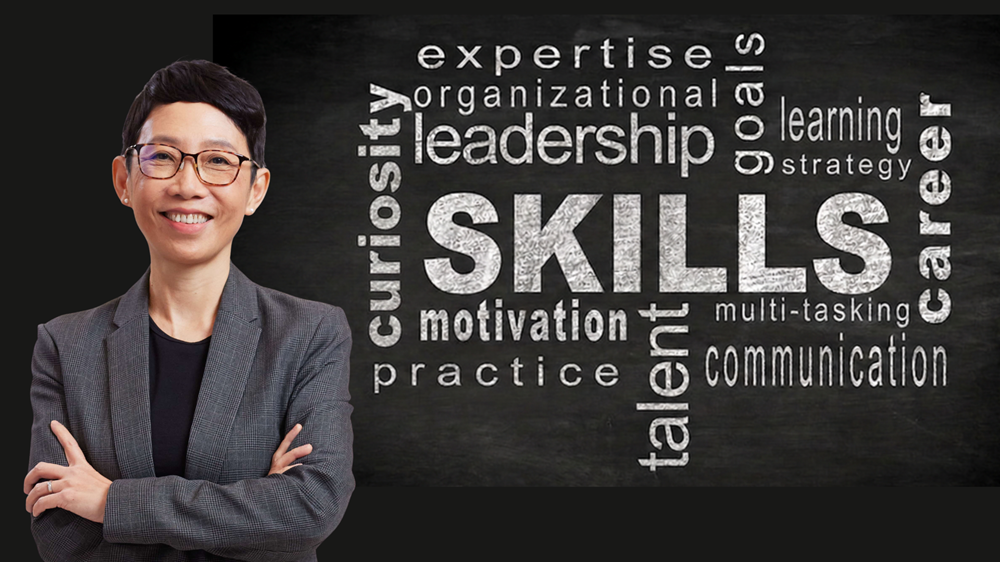
“Don’t miss the forest for the trees,” Associate Professor (Practice) Gog Soon Joo says.
She is talking about a familiar instinct when skills gaps emerge: launch another training programme or expand training provision.
But courses alone are only part of the answer to skills shortages. A programme may address an immediate need; what matters just as much is the ecosystem around it.
“You need very strong education and training institutions. You also need strong adult educators, research, labour-market intelligence, and industry engagement,” she says.
For Assoc Prof Gog, the real challenge is not simply to meet today’s skills needs, but to build a system ready for whatever comes next.
Building more than courses
It is a perspective Assoc Prof Gog is bringing to her recent appointment to the Global Advisory Panel on Skills (GAPS), an initiative of the World Bank Group and the Center for Global Development.
Bringing together international researchers, policymakers, practitioners, and industry leaders, GAPS examines what works in skills development and how effective approaches can be applied across low-and middle-income countries.
For Assoc Prof Gog, who also advises on panels such as World Economic Forum’s Global Future Council for Human Capital Development, the GAPS appointment offers a chance to draw on Singapore’s own journey.
“Singapore has spent six decades building up its workforce and skills ecosystem, from the early days of night schools and technical training to advocating for skills-first practices today. I’ve been extremely fortunate to have worked in so many different roles within the ecosystem,” she says.
Her career has spanned several stages of Singapore’s workforce transformation, from the development of the Workforce Skills Qualifications system to national skills frameworks and jobs-skills intelligence, giving her a close-up view of what it takes to build a resilient system. “Singapore still has a way to go, but I think we have some lessons that we can humbly share,” she says.
One is the country’s commitment to investing in people through education and lifelong learning. Another is its ability to execute policies by bringing institutions, partners and stakeholders together.
“And the third is trust,” she adds. “Over time, people need to see that the system can deliver the outcomes it sets out to achieve.”
From providing opportunities to skills ownership
Singapore may have many of the foundational building blocks for workforce transformation in place, but the journey is far from over.
“We are always fine-tuning our system,” Assoc Prof Gog says. Different periods have brought different priorities, from lower-wage workers to mid-career transition and an ageing workforce.
Skills-first, she believes, represents the next stage of that evolution.
For decades, much of workforce development has focused on the supply side: providing courses and infrastructure and removing barriers to learning.
“No money? We have subsidies and SkillsFuture Credit. No time? We have modular, online and workplace learning. Don’t know what to learn? We have information on jobs and skills,” she points out.
The next challenge is helping individuals make active use of these resources, to assess their skills, explore options, and make informed career decisions.
“We’ve started talking about career health as a nation,” she says. “The issue is that career health can easily take a back seat because we are so busy with work and life.”
For workers, Assoc Prof Gog believes career reflection needs to be built into natural touchpoints: a performance discussion, a conversation with a supervisor, career coaching or even the point at which someone is considering signing up for training.
“We need to create the space to think about our careers: where we want to go next, whether we have the skills to get there, and what we need to do if we don’t,” she says.
Making Skills-First easier to practise
Employers are the other half of the skills-first equation.
Singapore has already made progress in skills-first hiring. In 2025, 79.6 per cent of employers surveyed said academic qualifications were no longer the primary consideration in hiring, with greater emphasis placed on experience and demonstrable skills.
The harder next step is what happens after hiring: how organisations recognise, deploy, and develop the skills their people already have.
This is especially challenging for small and medium-sized enterprises (SMEs), which employ more than 70 per cent of Singapore’s workforce but often operate with lean teams and limited HR capacity.
That means meeting enterprises where they are.
“At Centre for Skills-First Practices, we are developing simpler approaches to human-centric work redesign for resource-constrained workplaces, alongside more comprehensive frameworks for organisations with greater capacity,” Assoc Prof Gog says.
“The aim is not a one-off redesign exercise, but to help companies build the capability to redesign jobs as technology, business models, and workforce needs change,” she adds.
Ultimately, Singapore is pushing for skills to be a “common currency” for decisions around hiring, mobility, deployment, and development.
“A mid-career switcher, for example, may not yet be fully proficient in a new field, but could bring 10 or 15 years of transferable experience in areas such as people management,” she says. “The question is whether employers are willing to open the door and give them the chance.”
Beyond the middle mile
The move towards skills-first also raises a challenge closer to home for IAL: what should training providers and adult educators be responsible for?
“We have focused on what I call the “middle mile”, i.e. designing learning, choosing pedagogies, engaging learners, and assessing them,” Assoc Prof Gog explains. “But in a skills-first economy, this is not enough.”
There is also a first mile: helping learners decide whether a course is right for them and worth the investment of time and money. Then comes the last mile: ensuring that learning translates into opportunities to apply new skills.
“If a learner is unable to secure an interview in the field they are trying to move into,” Assoc Prof Gog says, “then we need to ask what more can be done to bridge the last mile.”
In Singapore’s training and adult education landscape, things have started changing.
“There are progressive training providers that now screen learners before enrolment, help them articulate their prior experience, and work with employers to arrange interviews and gather feedback on work performance,” she shares.
This is critical because a skills-first system ultimately depends upon trust. Learners need to trust that investing in learning can lead somewhere. Employers need to trust that a person who claims a skill can demonstrate it. Training providers and adult educators bridge the two by helping to reduce the risk and uncertainty of achieving these outcomes for both the individuals and employers.
“Moving ahead, our adult educators would have to go beyond transferring knowledge to help people connect learning with work, careers, and demonstrable competence,” says Assoc Prof Gog.
Stay curious, stay a learner
Having spent more than two decades pushing for workforce transformation, Assoc Prof Gog believes deeply that change can start small.
“No matter how small our area or scope of work is, we can influence,” she says. “We can initiate change and have the courage to do the right thing.”
Alongside that drive for change is a constant curiosity and a deep belief in helping people realise their potential. “The ability to learn, to be a curious learner, is the top skill anyone can have,” she says. She deliberately ventures into areas where she knows she is not yet competent, because that is where she believes growth happens.
That belief extends to how she leads others. “As leaders, it is about how we create opportunities to grow people and develop them through work,” she says.
In a sense, that is what a skills-first society ultimately comes down to: people who are willing to keep learning, leaders who are willing to create room for others to grow, and enough of us willing to ask, what is the right thing to do next?