 Back
Back
But adoption is no longer the main question confronting economies. As AI adoption becomes normalised in the workplace, an increasingly pertinent question is: Is AI use deskilling the users?
Building capabilities is as important, if not more
Think about how we acquire skills and the ability to judge good work from bad.
When developing course materials, educators often revise content several times, adapting lessons to learners’ needs, selecting examples that resonate, and refining their approach through feedback and observation. This iterative process strengthens both their professional judgement and their course development skills.

The International Survey on Artificial Intelligence in Higher Education, Training and Adult Learning, led by IAL in Singapore, gathered responses from nearly 2,000 adult educators across 36 countries. Central to the survey’s rationale is that AI success should not be measured by time saved, cost reduced or tools adopted alone. Instead, policymakers and enterprises should ask if AI use also leads to richer work roles, stronger professional judgement, better outcomes, higher job satisfaction, and clearer career pathways.
Augment, not replace
In her chapter Towards Educator-AI Co-Intelligence Synergy, from a book she recently co-edited, Associate Professor Chen argues that keeping humans central to training, interpreting, and governing AI systems requires a deliberate design choice: learning and work systems must “preserve and extend human expertise in partnership with intelligent tools.”
Given that generative AI is fundamentally a statistical prediction system with inherent biases and flaws, keeping humans in the loop as auditors of AI output is critical to the long-term sustainability of any enterprise that has adopted the technology.
Designing work to continually build and augment human capability, rather than simply replace it, is thus essential to sustaining institutional knowledge, professional expertise, and future innovation. This reinforces the importance of capabilities that cannot be automated easily: critical thinking, ethical reasoning, creativity, and reflective practice.
In the case of training and adult education (TAE), this means using AI not simply to automate lesson planning, assessment drafting and administration, but to free educators to focus on higher-value work such as designing authentic workplace learning experiences, providing personalised coaching, using learning analytics to improve learner support and programme evaluation, and partnering with employers on workforce capability development.
TAE’s next challenge: from adoption to readiness
Educators are already experimenting actively with AI, largely on an individual basis. Organisational readiness, however, has not kept pace with individual adoption. Globally, more than 60 per cent of organisations still lack clear AI strategies, guidance or resources.
In Singapore, only 27.2 per cent of respondents said their organisations had a clear AI roadmap, despite the country’s national AI and digitalisation drive. At the same time, 86.6 per cent wanted more AI-related professional development — the highest proportion among the countries surveyed.
For Singapore’s TAE sector, these findings present both a challenge and an opportunity. The country has built a strong foundation in digital transformation and skills-based workforce development.
The next phase of progress for TAE will depend not simply on whether educators adopt AI, but on whether institutions can support them in using it effectively, responsibly, and in ways that continue to strengthen professional judgement. This requires moving beyond individual capability-building towards coordinated readiness across organisations and the wider sector.
Building towards co-intelligence
For a practical way to understand how organisations are using AI, Associate Professor Chen’s Co-Intelligence Matrix (CIM) offers a framework. The CIM looks at two key questions: whether AI is mainly being used to automate tasks or to support human work, and whether organisations have the capabilities and systems needed to use it well.
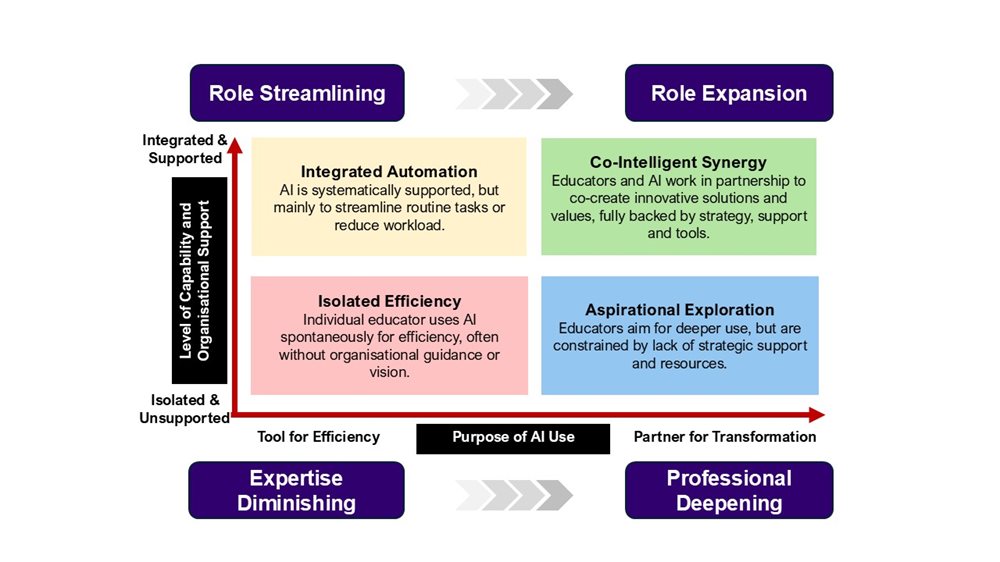
Chen describes the ideal outcome as “co-intelligence synergy”, where AI and human expertise work together, and AI use strengthens instead of eroding human expertise. For Singapore’s TAE sector, reaching this point will take more than introducing new tools. It will also require supportive leadership, sustained institutional commitment and a shared view of how AI can strengthen the role of adult educators.
Takeaways for TAE practitioners
First, AI training should not be treated as a one-off exercise. Educators need ongoing opportunities to build confidence with the technology while also learning how to use it thoughtfully in teaching, navigate ethical concerns and reflect on what works.
Second, educators should also have a say in how AI is introduced into learning environments. Their understanding of learners, workplaces, and teaching practice can help ensure that AI improves the quality of learning, rather than simply speeding up existing tasks.
Third, at the organisational level, clear direction matters. Leaders need to set out how AI should be used, put appropriate safeguards in place and create opportunities for educators to learn from one another. Educators have already shown that they are willing to experiment. The next step is to give them the support and structure to turn promising practices into wider, lasting change.
Finally, organisations should also look at whether AI is helping educators build new capabilities, improving learner outcomes, and making work more meaningful. Chen’s research suggests that while AI can increase efficiency, fewer educators are seeing more challenging work or better career progression. Closing this gap should be a priority for Singapore’s adult learning system.
From AI adoption to AI leadership
Singapore has already built strong momentum in AI adoption. For the industry, the next challenge is ensuring that this adoption translates into capability building.
Productivity and capability are closely linked: productivity reflects what people can achieve today, while capability shapes what they will be able to contribute tomorrow. In an AI-driven economy, organisations that invest in capability are also investing in their future productivity and resilience.
For the TAE sector, AI leadership will not be measured by how many tools are introduced or how much time they save. It will be measured by whether institutions can use AI to deepen human expertise, strengthen professional judgement and create better outcomes for learners and the workforce.
Associate Professor Chen Zan's recent research into AI adoption, supported by IAL and published in Navigating the AI Frontier in Adult Education (Routledge, 2026), provides timely insights into how AI is changing the role of adult educators and the institutions that support them. Click here to read her chapter.