 Back
Back
Everyone is rushing to train workers in AI. But here’s the harder question: are they learning to use it in ways that actually matter?
Training that introduces individuals to AI tools, prompts and basic techniques kickstarts workers’ AI awareness and equips them with basic knowledge, but it does not mean all learners can intuitively know how to apply the learnings at work, solve operational challenges or create workplace value. This is the gap IAL wants to address through Domain+, a new approach developed by its Adult Learning Collaboratory (ALC).

From AI-first to Domain-first
The idea behind Domain+ is simple but powerful.
Instead of starting with the technology, Domain+ starts instead with workers’ domains: the actual work, problems, and opportunities that workers know best. AI tools are then introduced as resources that can help them explore, test, and refine solutions in context.
Flipping this around is critical because AI is more powerful when shaped by human judgment. A worker will not use AI well simply by learning generic prompts. They need to see how AI can be applied within their field, responsibly and creatively.
Domain+ therefore aims to develop “AI-bilingual” experts — people who can speak both the language of their domain and the language of AI. These are the people who can connect industry knowledge with AI-enabled possibilities.
Stronger ideas, Greater readiness
Early experiments by ALC suggest that Domain+ can make a measurable difference.
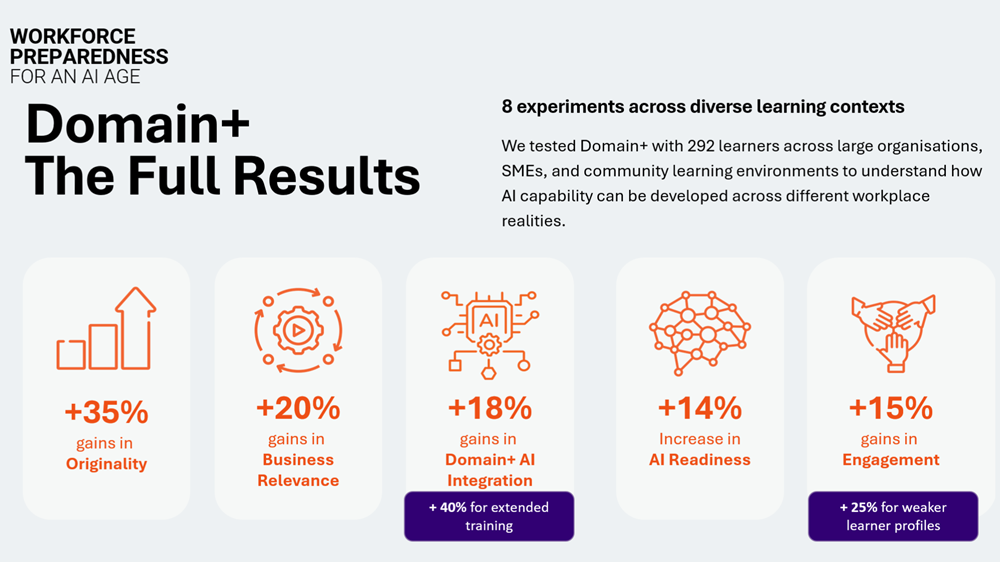
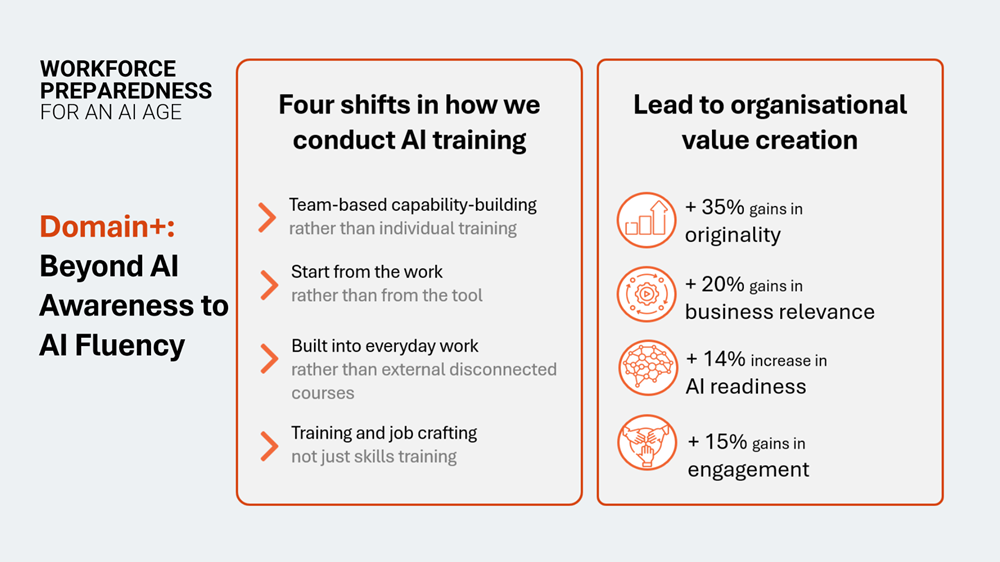
Across eight community-based experiments involving 292 learners, Domain+ outperformed standard AI training approaches. Learners produced AI solutions at work that were 35% more original. They also reported 14% more ready for AI-enabled work.
Engagement improved too. Overall learner engagement rose by 15%, with stronger gains of 25% among weaker learner profiles. Learners also became better at connecting their domain expertise with AI tools, with an 18% improvement overall, rising to 40% in longer-form training.
These results are notable because originality is hard to teach. In many AI courses, learners understand the tool but tend to produce ideas that resemble trainer examples. Here, Domain+ shows it is possible to help workers move beyond copying examples to learning to think with AI.
For employers, that is the bigger prize. When employees can generate stronger AI-enabled ideas, organisations are more likely to see AI as a way to enhance human capability, rather than simply reduced manpower needs.
Lifting “weaker learners”
One compelling finding is Domain+’s impact on learners who may otherwise struggle with AI training.
In an experiment involving Cragar Industries and Gill Technologies, 18 employees underwent Microsoft Power BI training using the Domain+ approach. The experiment compared workers with stronger technology proficiency against those with more moderate proficiency.
As expected, the more tech-proficient group progressed more independently. But the less tech-proficient group eventually produced dashboards of comparable quality. More significantly, this group recorded a 50% increase in learner engagement, compared with 13% among the more tech-proficient group.
This finding challenges a common assumption: that less tech-savvy workers are naturally harder to engage or less able to benefit from AI training.
Domain+ works by giving learners a clearer reason to engage. When AI is not presented as an external technical demand, it becomes a way to improve the work they already understand and care about.
Learning as a team sport
Another important departure from standard AI training is how Domain+ places strong emphasis on collective learning, instead of focusing on the individual learner’s competence.
This was seen in an experiment involving Gill Technologies, Singapore University of Social Sciences and IAL, which compared individual learners with natural workgroups.
Individual participants were largely drawn from an existing Microsoft Copilot initiative and were more motivated to learn AI. The team-based participants, by contrast, were nominated by managers. Most of them had no prior Copilot access, performed fewer advanced digital tasks at work, and showed lower engagement at the start of the training.
Yet despite these disadvantages, the natural workgroups ultimately produced stronger AI solutions. When colleagues learn together around shared workplace problems, they can draw on one another’s experience, challenge assumptions, and build solutions that better reflect organisational realities.
For enterprises, this is a crucial lesson. AI transformation cannot be reduced to sending individuals for courses. It requires teams to develop shared ways of identifying problems, testing ideas, and deciding how AI should be used at work.

From AI users to AI shapers
Perhaps the most future-oriented aspect of Domain+ is that it aims to move workers beyond simply using AI tools. It helps them become people who can shape how AI is used at work.
This was seen in the ReGen StoryLabs experiment conducted by DeepHumanity.AI, White Byte, and IAL. In this longer-form Domain+ programme, 16 women took part in 64 hours of learning over 10 weeks. The programme helped participants explore AI not only as a tool for automation, but also as a way to support creativity, professional growth, and new ways of working.
The deeper design produced the strongest results in domain-AI integration, with a 40% improvement. Five participants also showed evidence of “AI shaping” in their post-class tasks — meaning they were not just applying AI tools, but adapting and directing them in ways that reflected their own goals, expertise, and work contexts. This pattern was not observed in the other experiments.

This points to where AI skilling needs to go next. The future workforce will not only need people who can follow AI-generated workflows. It will need people who can question them, improve them and decide when they should or should not be used.
Building human capability for an AI future
The Domain+ findings carry an important message for those who design and deliver AI training. Learners are not simply passive, resistant, or lacking in ability. Across the experiments, their engagement and performance shifted when training was designed around their expertise, workplace context and opportunities to solve problems together.
For workforce specialists, AI trainers and workplace facilitators, this calls for a rethink. AI skilling cannot be reduced to transferring technical knowledge. It requires learning environments where workers can mobilise what they know, engage with uncertainty, and build AI-enabled solutions with others.
At its core, Domain+ responds to a critical question: how can workers remain valuable in an AI-enabled future? The answer cannot be more technical training alone. Tools will change. Platforms will evolve. Today’s prompts and workflows may quickly become outdated.
What workers need is more durable: the ability to connect domain expertise with emerging technologies, work with others to solve complex problems, and keep adapting as work changes.
Through Domain+, IAL is helping to build that future-ready workforce — one where AI transformation begins not with the machine, but with the knowledge, judgment and imagination of people.