 Back
Back
Most Small and Medium Enterprises (SMEs) are not short on ambition. What many struggle with is to reap returns even with investments into workforce training and development of innovative solutions.
The predicament is perhaps rooted in two causes – that even after training, skills acquired are not effectively deployed to enhance staff capabilities to drive firm-level performance; SMEs also might be unable to offer products and services with unique selling points, weakening their business outcomes in the globally competitive economy.
Today, many businesses in Singapore still drive innovation as a top-down initiative, with owners setting directions on new ways to move the business forward. The challenge is that when decision-making is too far removed from day-to-day operations, these efforts may miss valuable frontline insights and fail to gain traction. Bridging this gap may not require a complete overhaul, but a shift in mindset—towards involving those closest to the work in shaping how the business evolves.
IAL’s latest initiative, the People-driven Innovation in Enterprises (PIE) programme, is designed to address this disconnect by advancing a fundamentally different premise – instead of treating innovation as a top-down directive or a standalone project, it positions frontline employees as the engine of business transformation.
The predicament is perhaps rooted in two causes – that even after training, skills acquired are not effectively deployed to enhance staff capabilities to drive firm-level performance; SMEs also might be unable to offer products and services with unique selling points, weakening their business outcomes in the globally competitive economy.
Today, many businesses in Singapore still drive innovation as a top-down initiative, with owners setting directions on new ways to move the business forward. The challenge is that when decision-making is too far removed from day-to-day operations, these efforts may miss valuable frontline insights and fail to gain traction. Bridging this gap may not require a complete overhaul, but a shift in mindset—towards involving those closest to the work in shaping how the business evolves.
IAL’s latest initiative, the People-driven Innovation in Enterprises (PIE) programme, is designed to address this disconnect by advancing a fundamentally different premise – instead of treating innovation as a top-down directive or a standalone project, it positions frontline employees as the engine of business transformation.
A different diagnosis of the SME challenge
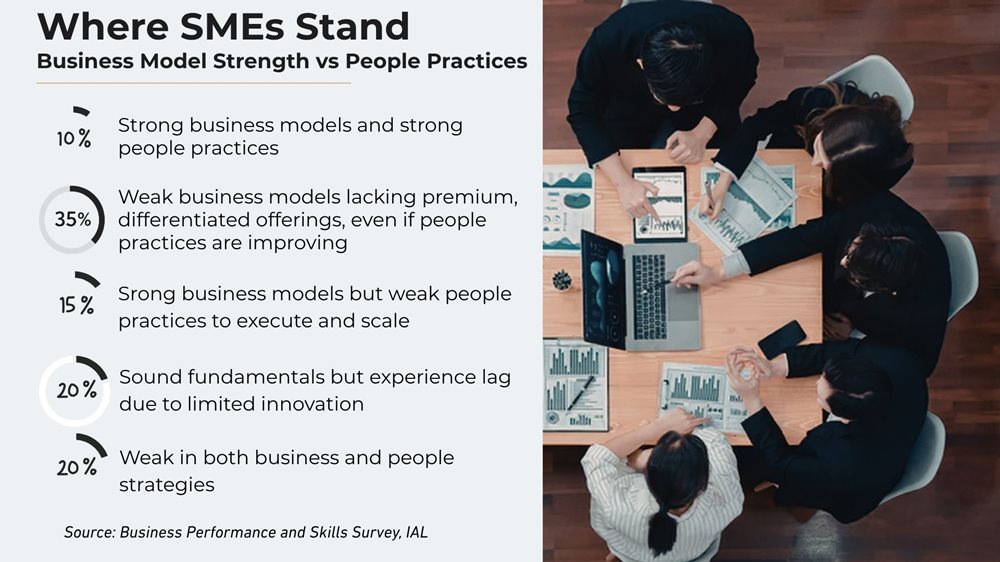
IAL’s research shows that around nine in 10 SMEs face some form of business model challenge, ranging from lacking differentiated offerings to limited innovation and weak people strategies. IAL also found that while the most profitable and innovative firms are those that best harness their workforce to drive growth, only one in 10 SMEs do this. Furthermore, SME workers in Singapore have skills proficiency comparable to those in larger firms, but their skills are frequently underutilised in their jobs.
By adopting and adapting the best practices of top-performing SMEs, PIE aims to help local companies transform and achieve stronger profits, revenue, and market share through three key elements: diagnostics, innovation, and workplace learning.
From diagnostics to action
PIE begins with a data-driven diagnostic, benchmarking firms against both top-performing SMEs and peers that have undergone similar transformation journeys.
The 100-question diagnostic tool, called Enterprise Compass, assesses business strategy, innovation, and people practices, helps organisations identify priorities to act on.
This comparison serves a critical purpose. It does not just show companies where they stand but also grounds recommendations in what is realistically achievable. For SMEs that are often resource-constrained, this balance between aspiration and practicality is essential.
Innovation driven from within
What distinguishes PIE is its fundamental philosophy.
Instead of relying on external experts to design solutions, the programme activates the teams who are closest to the business, i.e. those who interact with customers, manage operations, and understand day-to-day realities.
Through the process, employees are guided to develop deeper customer insights, build market-sensing capabilities, think in terms of commercial impact, and use AI-enabled tools to support decision-making and experimentation.
This is where workplace learning becomes central and embedded into the work itself through reflection, experimentation, and shared problem-solving.
To fit SMEs’ operational realities, the programme is deliberately structured to deliver work-integrated learning in focused bursts over nine to 12 months. Each burst is built around day-to-day work and requires about two hours per week. By combining coaching with real workplace projects, participants can apply the learning immediately.
Over time, this creates what IAL describes as generative workplace learning: the ability for teams to continuously create new knowledge together as they solve real business challenges.
Building capabilities that stick
A common weakness in transformation programmes is sustainability. Even when new ideas succeed, they often fail to take root. PIE addresses this through its “sustain” phase, where successful innovations are translated into organisational systems.
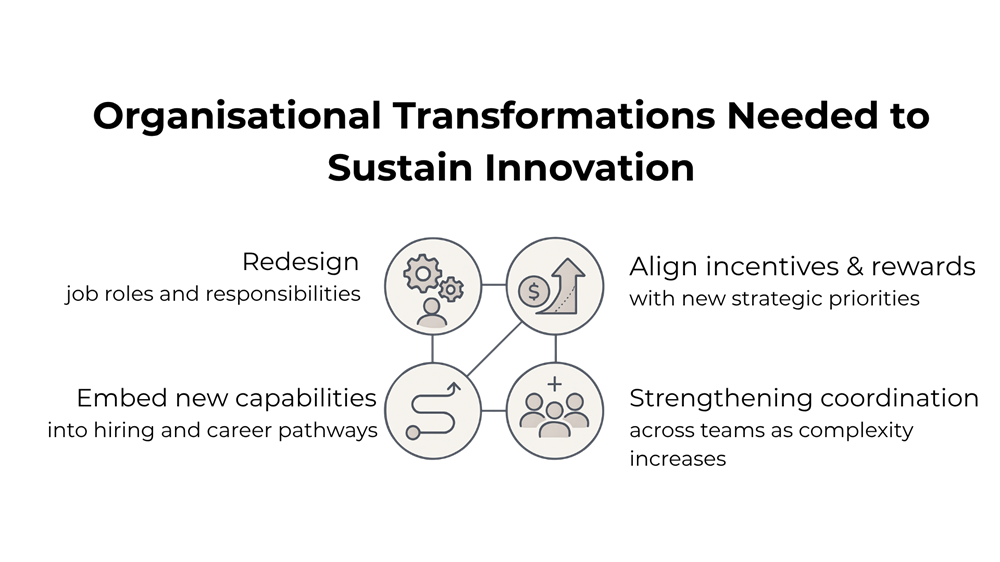
In parallel, firms can develop targeted capabilities through “capability pods”, or focused skill-building efforts linked directly to business needs, such as AI adoption or advanced customer analytics. These efforts ensure that innovation becomes systemic and sustainable in the long term.
Rethinking growth at Raffles Strata Management
For local SME Raffles Strata Management (RSM), the PIE approach came at a critical juncture.
Operating in a highly competitive strata management sector, the company faced a familiar risk: limited differentiation in a market where services can quickly become commoditised. Internally, strategy and innovation were largely driven by management, while its 100-strong workforce remained focused on operations—leaving much of its frontline capability underutilised.
Using the Enterprise Compass, RSM identified a deeper issue: challenges in sustaining growth and customer retention. “The Enterprise Compass is the first report that presented my organisation in an accurate and explicit way,” said CEO Mr Ken Ng. The findings prompted a move towards ground-up innovation.
Mr Ng chose to empower his employees to lead the effort. For a workforce accustomed to clearly defined roles, this was initially unsettling, requiring them to step beyond job scopes and engage in new forms of collaboration and problem-solving.
Rethinking growth at Raffles Strata Management
For local SME Raffles Strata Management (RSM), the PIE approach came at a critical juncture.
Operating in a highly competitive strata management sector, the company faced a familiar risk: limited differentiation in a market where services can quickly become commoditised. Internally, strategy and innovation were largely driven by management, while its 100-strong workforce remained focused on operations—leaving much of its frontline capability underutilised.
Using the Enterprise Compass, RSM identified a deeper issue: challenges in sustaining growth and customer retention. “The Enterprise Compass is the first report that presented my organisation in an accurate and explicit way,” said CEO Mr Ken Ng. The findings prompted a move towards ground-up innovation.
Mr Ng chose to empower his employees to lead the effort. For a workforce accustomed to clearly defined roles, this was initially unsettling, requiring them to step beyond job scopes and engage in new forms of collaboration and problem-solving.
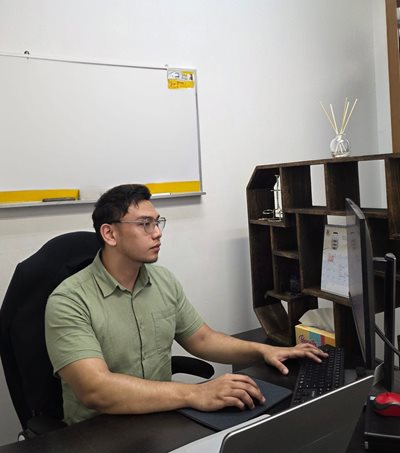 |
A team led by Syawal Bin Zaaba (left) stepped forward. Drawing on insights from frontline teams who engage residents daily and navigate recurring operational gaps, they began rethinking how the business could operate differently. This led to the development of MCST Pro, an integrated digital platform that brings together functions such as e-AGM management, work reporting, and real-time operational insights. Initially conceived as an internal tool, it was refined through frontline input to address fragmented systems, communication gaps, and difficulties in tracking issue resolution, ultimately enabling more coordinated and responsive service delivery. The project reflects key principles of the PIE programme: innovation driven by employees closest to the work, structured experimentation through iterative development, and a clear focus on business outcomes. |
Just as importantly, the process became a capability-building exercise. Employees developed skills in digital thinking, collaboration, and customer engagement—and gained confidence in contributing to strategic decisions.
The road ahead
Innovation has long been promoted as everyone's responsibility. Yet in practice, it is still frequently treated as the domain of specialists, innovation teams or external partners, leaving many employees as implementers rather than active contributors to how work evolves.
PIE overturns that model. It brings innovation back into the flow of work, where those closest to the business are not just executing tasks, but shaping how the business evolves. In doing so, innovation transforms from a sporadic activity to a repeatable capability.
For SMEs, this new approach is both pragmatic and demanding. PIE offers a structured pathway to navigate transformation within real-world constraints. But it also requires a decisive change in mindset: to trust employees not just to deliver, but to think, experiment, and lead.
The road ahead
Innovation has long been promoted as everyone's responsibility. Yet in practice, it is still frequently treated as the domain of specialists, innovation teams or external partners, leaving many employees as implementers rather than active contributors to how work evolves.
PIE overturns that model. It brings innovation back into the flow of work, where those closest to the business are not just executing tasks, but shaping how the business evolves. In doing so, innovation transforms from a sporadic activity to a repeatable capability.
For SMEs, this new approach is both pragmatic and demanding. PIE offers a structured pathway to navigate transformation within real-world constraints. But it also requires a decisive change in mindset: to trust employees not just to deliver, but to think, experiment, and lead.
To participate in PIE, interested enterprises can reach out to IAL at [email protected]. Eligible SMEs can receive up to 90% consultancy grants of the NACE@IAL.