 Back
Back
For learning and development, this poses a fundamental question: how can training prepare workers not just to know more, but to think, adapt and act more effectively when the situation itself is changing?
This is the challenge that IAL, through its Adult Learning Collaboratory (ALC), has been exploring through a series of experiments centred on future-oriented pedagogies (FOP).
Learning for a more uncertain world
Recognising that ambiguity has become a defining feature of today’s workplace, IAL’s ALC project explored how learning can equip workers to question assumptions, interpret changing situations, make sound decisions, and adapt with confidence.
Across the project, IAL worked with 762 worker-learners, 43 educators and facilitators, and eight organisations across different sectors. In total, 86 learning interventions were studied.
The experiments focused on two future-oriented learning techniques: emergent scenarios and generative dialogue.
Emergent scenarios require learners to respond to situations that evolve, change or remain uncertain, much like the realities they encounter at work. Instead of working through fixed answers, learners and workers are invited to consider shifting conditions, weigh options and make decisions in context.
Generative dialogue, meanwhile, encourages learners and workers to discuss ideas, challenge assumptions and build understanding collaboratively. It moves learning beyond individual absorption of information towards shared meaning-making and collective problem-solving.
What the experiments found
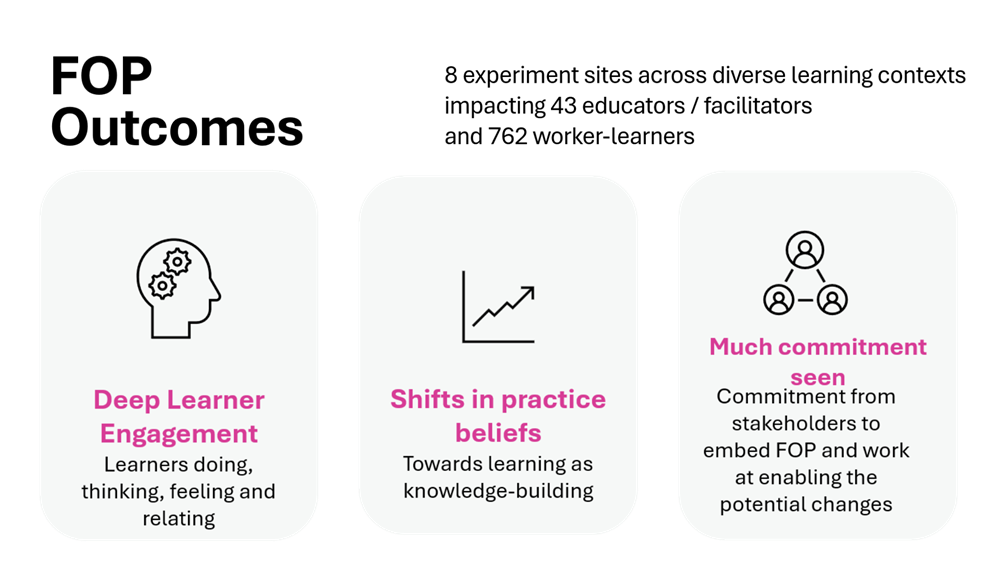
Importantly, the project also showed that FOP is not confined to formal classroom settings. Its techniques can be applied in authentic workplace contexts, where learning often happens through coaching conversations, team discussions, management interactions and everyday problem-solving.
This has broader implications for organisations. If workers are to become more adaptive, the supervisors, coaches and managers who guide them must also be equipped to facilitate better dialogue, reflection and learning at work.
Making learning visible through Lumina
A challenge in improving facilitation is that much of what happens in a learning session is difficult to observe systematically.
Educators may sense when a discussion has gone well, but it can be difficult to pinpoint why. Traditionally, assessing learning quality requires professionals to review sessions and give feedback, a process that can be labour-intensive, resource-heavy and intrusive.
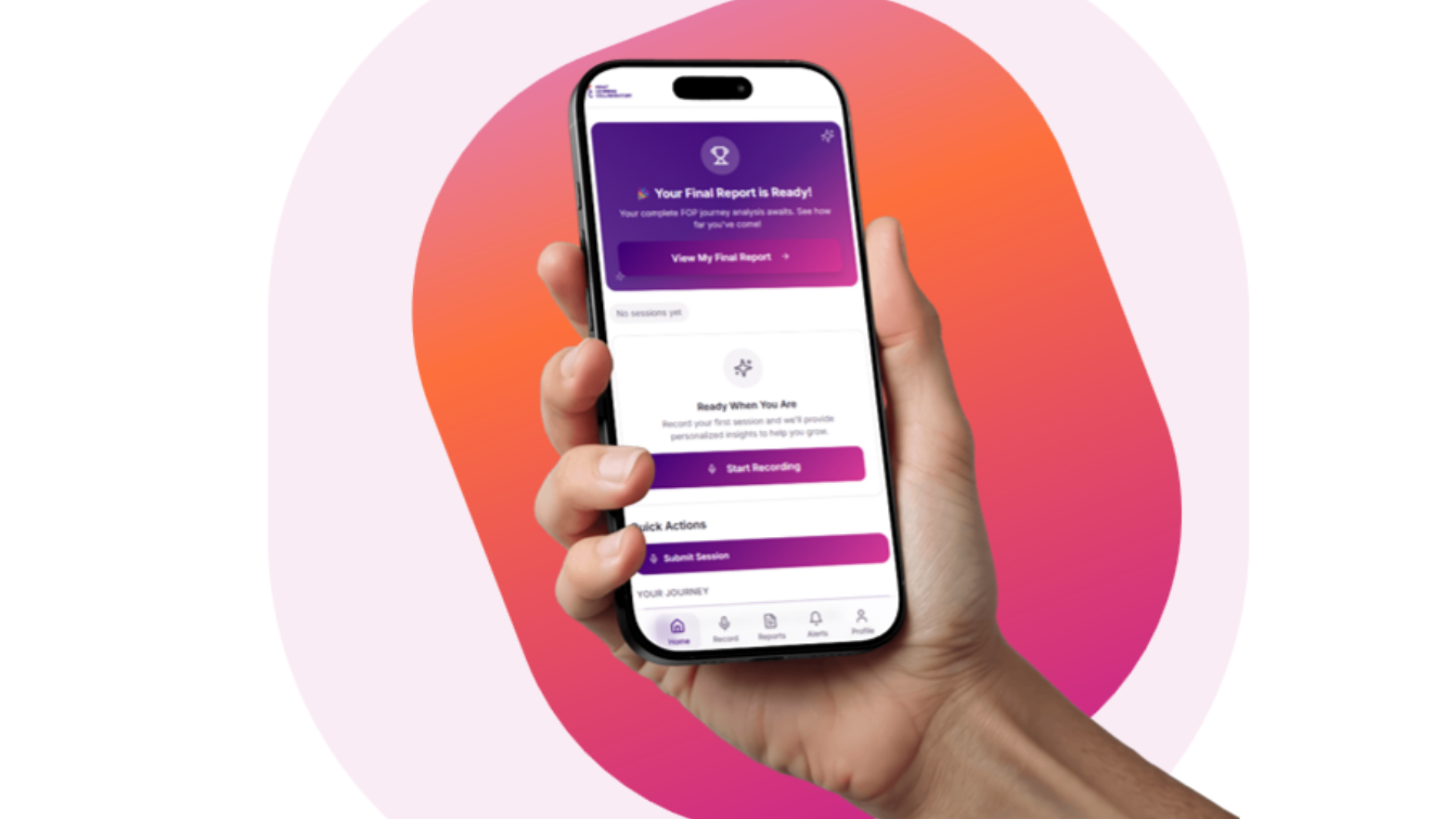
Lumina, an AI-enabled platform, was thus developed by the ALC to address these limitations.
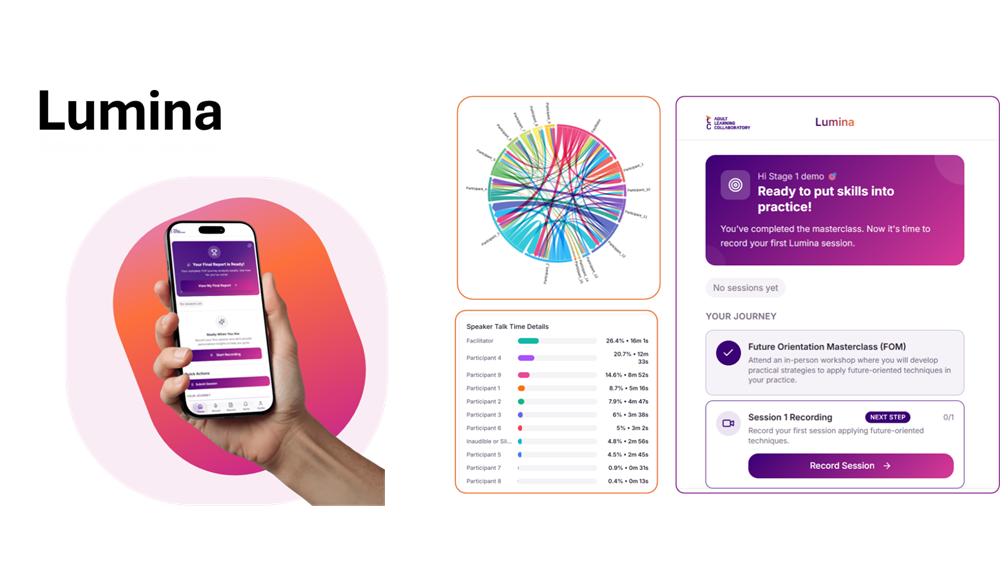
For example, Lumina shows how the techniques of emergent scenarios and generative dialogue are being used, where learners / workers are most engaged, and which areas of facilitation could be strengthened.
This moves evaluation away from external observation alone towards guided self-reflection. Educators, facilitators, leaders and more can revisit their sessions, understand what worked, and make more informed decisions on how to improve.
Rather than replacing educators and facilitators, Lumina supports their professional growth by making learning interactions easier to observe and interpret. For IAL, this makes it a key part of scaling FOPs across adult training and workplace learning settings.
Supporting better conversations at work
The relevance of Lumina extends beyond formal training.
Ms Eileen Nah, Head of Leadership and Strategy faculty at OCBC, shared that the bank saw value in Lumina’s ability to support greater self-reflection among leaders by enabling them to revisit recordings of their own conversations.
“If you want to be a great manager or a great coach for your people, first listen to yourself,” said Ms Nah. “Now you have a tool that can help you reflect on how you can improve your dialogue and create more meaningful and productive conversations aligned to the outcomes you are trying to achieve.”
The organisation is currently exploring how Lumina can be adapted to better support its middle managers and workplace coaches in strengthening communication, coaching and leadership practices.
Reshaping how adult learning develops
The ALC experiments make one thing clear: preparing workers for the future is not simply about adding new content on AI, digital skills or innovation. It requires a more fundamental shift in how people learn.
By using FOP techniques such as emergent scenarios and generative dialogue and focusing on meaningful interaction, experimentation, reflection, and problem-solving, learners and workers build the habits needed to respond to complex and changing work realities. Lumina strengthens this by giving educators, facilitators and workplace leaders and coaches a way to see these practices more clearly and improve them over time.
The work is still evolving. The experiments show that FOP techniques are not yet consistently enacted across learning sessions, and meaningful adoption will take sustained effort. But they also point to a learning community ready to move beyond surface-level change.
The future of work will not be met by better content alone, but by better learning practices embedded into everyday conversations, decisions and workplace routines. Through FOP and Lumina, IAL’s ALC is helping to build the conditions for these capabilities to take root.